ERP Implementation Partner vs Vendor Direct: Which Should You Choose?
Quick answer: Going direct with the ERP vendor's professional services team works best when the implementation is standard, you don't need on-site presence, and the vendor has demonstrable local experience in your country and industry. An independent implementation partner is the better choice when you have meaningful operational complexity, region-specific compliance requirements (tax, payroll, banking, statutory reporting), or need consultants who can be on-site during go-live. For most mid-market implementations globally, an independent local partner outperforms a remote vendor delivery team.
It seems like a straightforward procurement decision: do you buy and implement the ERP through the vendor's own team, or do you engage an independent implementation partner?
It's not straightforward at all. And the wrong choice — in either direction — costs you time, money, and in some cases the project itself.
Here's what the ERP implementation partner vs vendor-direct decision actually comes down to.
What "Going Direct" Actually Means
Most major ERP vendors operate a hybrid commercial model. They have an internal professional services team that handles implementations directly, and they also have a network of certified implementation partners who sell and deploy the same software independently.
When you go direct, you engage the vendor's own services team. For some platforms — particularly smaller, more focused vendors — this means working with people who built the product and know it inside out. For the large platforms (NetSuite, SAP, Microsoft Dynamics 365, Oracle Fusion), it usually means working with the vendor's regional delivery centre, which may or may not be local to you.
This is where the nuance starts.
The Case for Going Direct With the Vendor
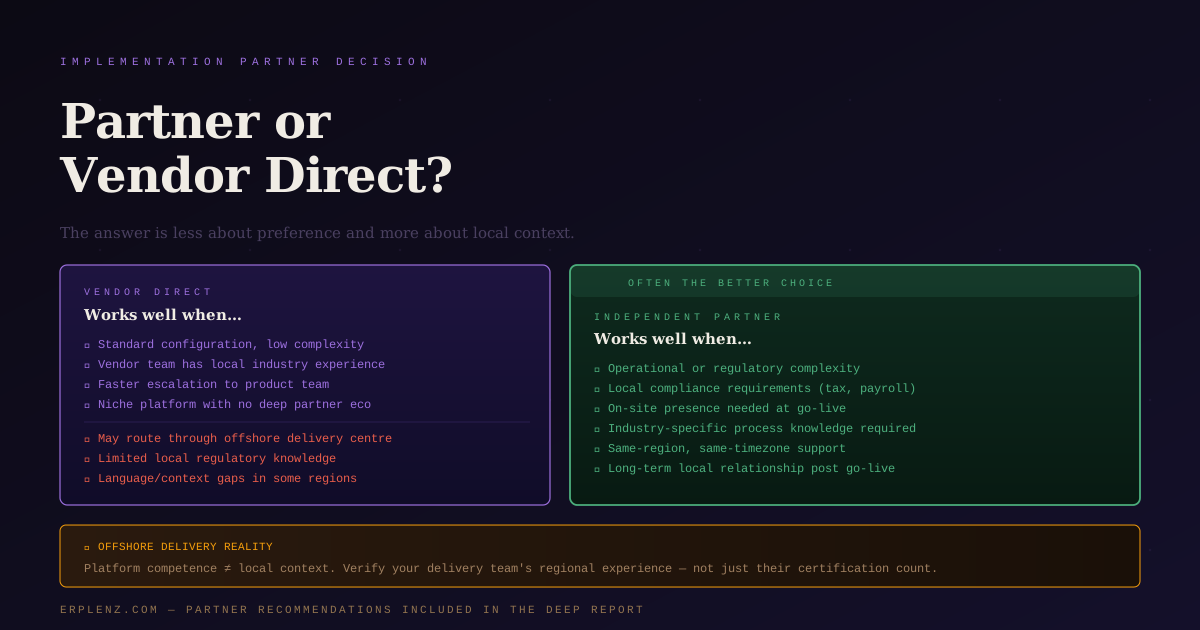
Going direct makes the most sense when the implementation is straightforward and the vendor's team genuinely has the expertise to deliver it.
If you're implementing a standard configuration of a well-defined platform — no heavy customisation, no unusual integrations, a single entity in a single country — the vendor's own team often knows their system better than any partner does. There's no translation layer. Support escalations go straight to the product team. Roadmap input is more direct.
For smaller, niche platforms especially, the vendor is the best implementation resource. There may not be a deep partner ecosystem to draw from, and a direct engagement is simply the most capable option available. (Our comparison of major ERP vendors vs niche industry ERPs covers when a niche platform is the right call in the first place.)
The Case for an Independent Implementation Partner
For most mid-market implementations, and virtually all complex ones, an independent ERP implementation partner delivers something the vendor's team structurally cannot: local context.
This is not a minor point.
ERP implementations are not purely technical exercises. They require someone who understands how businesses in your region actually operate — local tax legislation, local payroll requirements, local banking integrations, local compliance obligations. These are not global standards:
- VAT and GST: UK Making Tax Digital, EU e-invoicing (Italy SDI, France Chorus Pro, Germany B2B mandate from 2027), Australia GST, India GST and e-way bills, Saudi Arabia ZATCA e-invoicing, UAE VAT, South Africa VAT — every regime has unique configuration requirements
- Payroll: US multi-state payroll tax, UK PAYE and pension auto-enrolment, Australia STP Phase 2, Canada T4 reporting, India PF/ESI/TDS, statutory leave entitlements vary dramatically by country
- Banking integration: SEPA in the EU, Faster Payments and Bacs in the UK, ACH and Wire in the US, NPP in Australia, UPI in India, PIX in Brazil
- Statutory reporting: SOX (US), MTD (UK), SAF-T (Portugal/Norway/Romania), GSTR-1/3B (India), eNotaFiscal (Brazil), Peppol e-invoicing (Singapore, Australia, New Zealand)
A partner who has implemented the same system for businesses in your sector and your country carries this institutional knowledge. The vendor's offshore delivery team, in many cases, does not.
There is also the practical question of accessibility. A local partner can be on-site. They can sit in your office during the critical go-live week, walk the warehouse floor, observe a day-end process, and spot the issues that never surface in a remote session. When something breaks at 4pm on a Tuesday and you need a human being in the room, a partner two suburbs away is a fundamentally different resource from a support ticket to a delivery centre in a different timezone.
The Offshore Delivery Problem
This is an area that doesn't get discussed openly enough, but it affects a significant number of mid-market ERP projects worldwide.
Several large ERP vendors — particularly those serving the SME and mid-market segment — have built offshore delivery centres in India, the Philippines, Eastern Europe, and Latin America to reduce their implementation costs. These centres are often staffed with technically competent consultants who know the platform well. But competence on the platform is not the same as competence on your business.
When a consultant lacks familiarity with local regulatory requirements, local business norms, or even local terminology, the friction compounds across the entire project. Requirements gathering sessions take longer because context has to be re-established. Configuration decisions that would take an experienced local consultant ten minutes to make require three rounds of email to clarify. Edge cases that a local consultant would anticipate get discovered at UAT instead.
Language is a related issue that rarely appears in vendor proposals but absolutely surfaces during implementation. Not necessarily the inability to communicate — most offshore teams work in English — but the subtler problem of context. Industry-specific terminology, local business idioms, regulatory shorthand. These are the gaps that create misunderstandings in requirements documents that cost weeks to unwind in testing.
None of this is a criticism of the offshore delivery model in principle. It is a straightforward observation about fit. A consultant who has spent three years implementing your chosen ERP for businesses in your country and your industry will simply make fewer mistakes than one who hasn't — regardless of which country they're based in.
How to Evaluate an ERP Implementation Partner
If you decide to engage an implementation partner, the evaluation should be as rigorous as the ERP selection itself. A bad partner with a good ERP produces a bad implementation. The system is only as good as the people who put it in.
Questions that matter:
- How many implementations of this specific platform have you completed in the last 24 months? (Not total certifications — actual completed projects.)
- Can I speak with three reference customers who went live in the last 18 months, in my industry, in my country?
- Who specifically will be on my project? What is their individual implementation count on this platform?
- What is your escalation path when the project encounters a problem that requires the vendor's involvement?
- Are you onshore, and can your team be on-site during go-live?
- What is your partner certification tier with the vendor (e.g., NetSuite Solution Provider/Alliance, Microsoft Solutions Partner, SAP Gold Partner, Oracle Platinum Partner)?
- Do you have references in the specific countries we operate in?
- What is your post-go-live managed services offering, and what are your SLAs?
That last group of questions — particularly who specifically will be on my project — is the one most buyers forget to ask. Vendors and partners alike have a tendency to present their most experienced consultants in the sales process, then staff the project with more junior resources. Get the names of the actual project team in writing before you sign.
The implementation approach the partner proposes also matters. A partner pushing big-bang on a complex multi-entity rollout is a red flag — our guide to ERP implementation approaches explains why phased usually wins.
The Hybrid Reality: Partner for Delivery, Vendor for Support
For many mid-market implementations, the best outcome is a combination: an independent local partner for the implementation itself, and a direct support relationship with the vendor for ongoing maintenance and upgrades.
The partner knows your business and your configuration. The vendor knows the product roadmap and can resolve the deep platform issues that require product-level access. These two relationships are not in conflict — they complement each other. The implementation partner becomes your primary support resource for business process questions; the vendor is the escalation point for platform-level issues.
This pattern is particularly strong for NetSuite (where Solution Providers handle delivery and Oracle handles platform support), Microsoft Dynamics 365 (where Solutions Partners deliver and Microsoft handles cloud infrastructure), and SAP Business One (which is exclusively partner-delivered with SAP providing product support).
Multi-Country Implementations: A Special Case
For businesses with operations across multiple countries — common in mid-market and enterprise — the partner selection question has additional dimensions:
- Single partner with international presence: Big 4 firms (Deloitte, PwC, EY, KPMG) and Tier 1 SIs (Accenture, Capgemini, IBM, Infosys) can deliver across most major markets. Higher cost; consistent methodology.
- Lead partner + local partners: A primary partner manages the programme, with regional partners providing local execution and compliance expertise. Best for mixed-complexity deployments.
- Regional partners by country: Independent partners in each country, with internal programme governance. Lowest cost; highest coordination overhead.
The right pattern depends on the complexity of your operations and your internal programme management capability.
The Honest Summary
Go direct if: the implementation is standard, the vendor's services team has demonstrable local experience in your region and industry, and the project scope doesn't require deep on-site engagement.
Engage a partner if: you have meaningful operational complexity, local regulatory requirements that aren't global standards, or a need for on-site presence that the vendor's delivery model can't reliably provide.
Either way: evaluate the delivery team as carefully as you evaluate the software. The system doesn't implement itself.
Frequently Asked Questions
Should I use an ERP implementation partner or go direct with the vendor?
For most mid-market implementations, an independent implementation partner outperforms going direct with the vendor — particularly when local compliance, multi-entity complexity, or on-site presence matters. Going direct works best for straightforward single-entity deployments where the vendor's services team has demonstrable local industry experience.
Can I implement an ERP system without a partner?
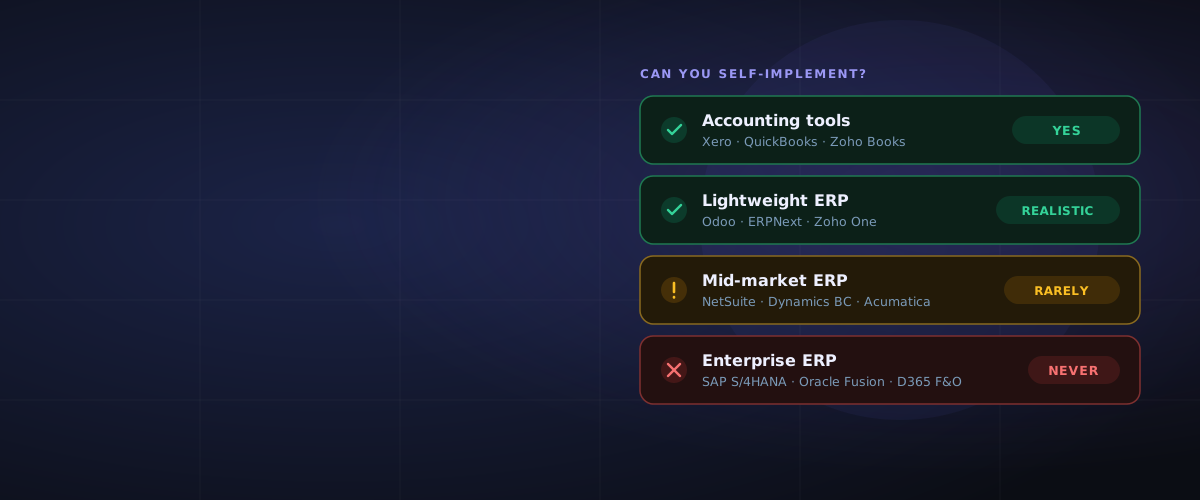
For small businesses on platforms like Odoo Community, ERPNext, or Zoho One — yes, particularly if you have internal technical capability. For mid-market platforms (NetSuite, SAP Business One, Microsoft Dynamics 365 Business Central, Acumatica, Sage Intacct), most vendors require or strongly recommend a certified partner, and DIY implementations of these platforms have a high failure rate. For a full breakdown of which systems you can realistically self-implement — and the blind spots to plan for — see Can You Self-Implement an ERP?
What is the difference between an ERP vendor and an implementation partner?
The ERP vendor builds and owns the software (Oracle owns NetSuite, SAP owns S/4HANA, Microsoft owns Dynamics 365). The implementation partner is an independent consulting firm certified by the vendor to sell and deploy the software. Partners often have deeper industry or regional expertise than vendor delivery teams, while vendors have deeper product-level expertise.
How do I choose an ERP implementation partner?
Evaluate four factors: (1) implementation count on the specific platform in the last 24 months (not lifetime certifications); (2) reference customers in your industry, country, and revenue band who went live in the last 18 months; (3) the named consultants who will actually work on your project, not the senior partners presenting the proposal; (4) clarity of scope, change control, and post-go-live support in the SOW.
Is it cheaper to go direct with the ERP vendor?
Not necessarily. Vendor delivery teams sometimes appear cheaper upfront but carry higher risk on complex projects, leading to scope changes that erode the saving. Independent partners often quote higher day rates but deliver faster on complex implementations due to local expertise. Total project cost is what matters — see our full ERP cost breakdown and implementation timeline guide.
What is an SI (Systems Integrator) and how is it different from an ERP partner?
System Integrators (SIs) are large consulting firms — Deloitte, Accenture, IBM, Capgemini, KPMG, PwC, Infosys, TCS — that deliver enterprise ERP programmes at large scale, typically for SAP S/4HANA, Oracle Fusion Cloud, and Microsoft Dynamics 365 F&O. They are functionally a category of ERP partner, but operate at a scale most mid-market implementations don't need. For most businesses below $250M USD revenue, a mid-sized regional implementation partner is a better fit than a Big 4 SI.
Can I switch ERP partners mid-implementation?
Yes, but it is painful and expensive. Knowledge transfer is rarely clean, configuration history is often poorly documented, and the new partner will rebuild your trust by re-validating decisions the previous partner made. Switching mid-project is sometimes the right call (when the existing partner is clearly failing), but it usually adds 3–6 months and 15–30% to the budget. The better strategy is rigorous evaluation upfront.
How ERPLenz Can Help
The ERPLenz Deep Report includes partner recommendations alongside your shortlisted platforms — identifying implementation partners in your region with documented delivery experience on the systems in your shortlist.
It's the same vendor-agnostic approach applied to the partner question: no referral fees, no preferred partner agreements. Just an honest view of who is best placed to deliver your implementation based on regional presence, industry experience, and platform certification.
Begin your free ERP assessment →
ERPLenz is a vendor-agnostic ERP selection platform serving businesses globally. Our consultants have hands-on implementation experience across NetSuite, SAP, Odoo, Microsoft Dynamics, Acumatica, and Sage — and partner recommendations are independent of any commercial referral relationships.