How Long Does ERP Implementation Actually Take? Honest Timelines by Business Size
Quick answer: Realistic ERP implementation timelines: 2–5 months for small businesses on Odoo, ERPNext, or Zoho One; 6–18 months for mid-market deployments on NetSuite, Business Central, or Acumatica; and 18 months to 4+ years for enterprise programmes on SAP S/4HANA, Oracle Fusion, or Dynamics 365 F&O. Independent research from Panorama Consulting and Gartner shows most projects run 30–50% longer than the original vendor quote. Data quality, internal resourcing, scope creep, integrations, and change resistance are the consistent timeline killers.
Vendor proposals quote timelines that sound reassuring: "3–4 months for a business your size." The reality, for most organisations, is longer. Independent research from Panorama Consulting and Gartner shows the majority of ERP implementations take 30–50% longer than the original estimate — and that's before accounting for the post-go-live stabilisation period where the business is running on the new system but not yet at full productivity.
This article gives you an honest picture of ERP implementation timelines by business size — not what vendors quote, but what businesses actually experience across North America, Europe, the UK, Australia, and emerging markets — and explains the specific factors that compress or extend every project.
Why ERP Timelines Are So Often Wrong
The vendor's quoted timeline is the best-case scenario: clean data, available internal resources, no scope changes, no integration surprises, and a team that fully understands the new system from day one.
None of those conditions routinely exist. The most common causes of timeline blowout are:
Data quality problems discovered mid-project: Legacy data is almost always messier than expected. Duplicate customer records, unmapped inventory codes, inconsistent chart of accounts structure, and years of workaround transactions all need to be cleaned and transformed. This takes longer than the quoted migration estimate virtually every time.
Internal resource availability: ERP implementations require significant input from the business's own team — finance, operations, IT, and management. These people have day jobs. When competing priorities pull them off the project, the timeline stretches.
Scope creep: As users engage with the new system, they identify requirements that weren't in the original scope. Each addition adds time. A project manager who says "yes" to every new request without adjusting the timeline is setting up a delay.
Integration complexity: Connecting the ERP to existing systems — payroll, eCommerce (Shopify, Amazon, BigCommerce), EDI partners, CRM (Salesforce, HubSpot), payment gateways, banking APIs — is consistently underestimated. APIs have quirks, data structures don't map cleanly, and edge cases surface in testing that weren't anticipated in design.
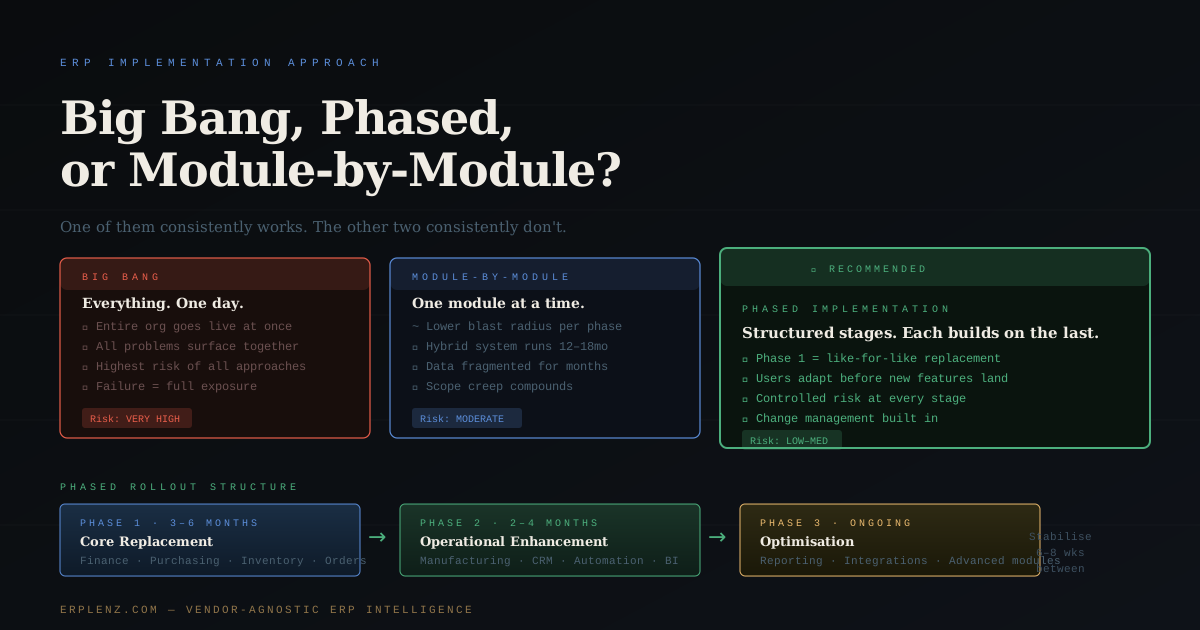
Change resistance: Users who don't want to change how they work slow down training, testing, and go-live sign-off. This is a people problem, not a technology problem, and it's the most consistently underestimated factor. Our guide on phased vs big bang implementation approaches explains why a like-for-like Phase 1 dramatically reduces this risk.
Localisation and multi-country complexity: Every additional country adds tax compliance, statutory reporting, language localisation, and regional banking integration. A second entity rarely doubles the timeline — it typically adds 30–60% on top of the single-entity baseline.
ERP Implementation Timeline by Business Size
Small Business (10–75 employees, $1M – $10M revenue)
Typical platforms: Odoo Community, ERPNext, Zoho One
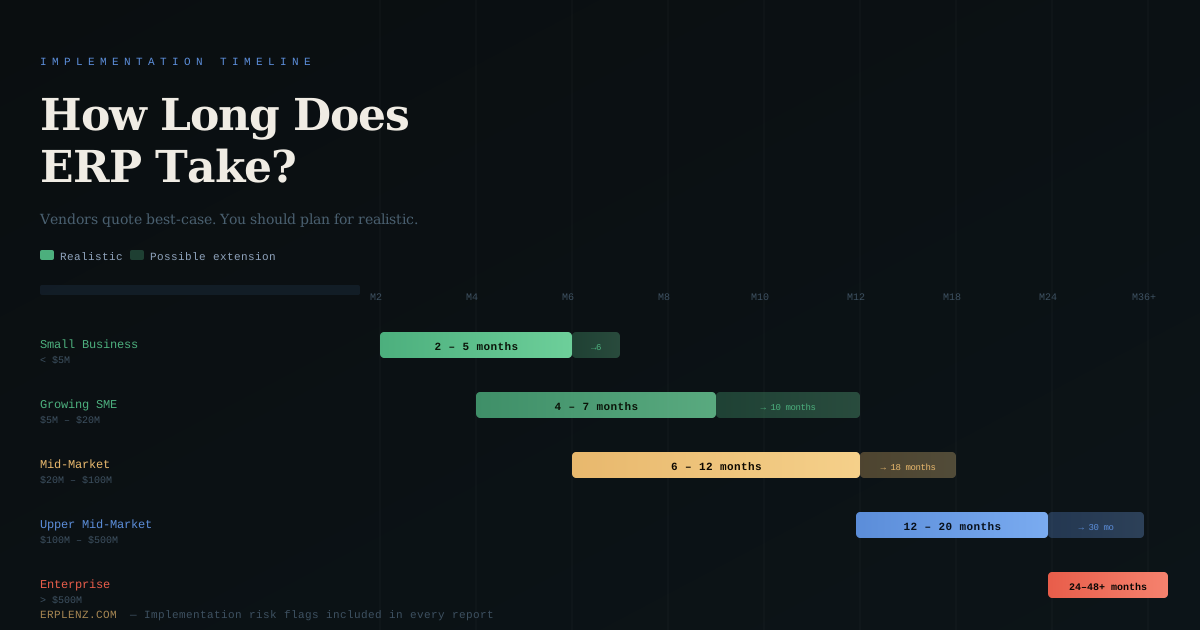
Realistic timeline: 2 – 5 months
Small business ERP implementations are the most variable in duration — not because the platforms are complex, but because internal capability gaps vary enormously. A technically confident team with clean data can go live on Odoo in 6–8 weeks. A business with two decades of data in disparate systems and a finance team that has never used an ERP may take 5–6 months.
The lean path for this tier:
| Phase | Duration | Key Activities |
|---|---|---|
| Discovery & configuration | 3 – 5 weeks | Chart of accounts setup, workflow mapping, user roles |
| Data migration | 2 – 4 weeks | Customer/supplier master, opening balances, inventory |
| Training | 1 – 2 weeks | Core user training, process walkthroughs |
| UAT & parallel run | 2 – 4 weeks | User acceptance testing, side-by-side validation |
| Go-live & hypercare | 2 – 4 weeks | Live system, issue resolution, process stabilisation |
What extends it: Poor data quality, limited internal time commitment, scope additions after kickoff, and integrations to third-party platforms (eCommerce, payroll, payment gateways) that weren't scoped upfront.
What compresses it: Clean source data, a dedicated internal project lead, minimal customisation, and a team that has been through an ERP implementation before.
Mid-Market (75–500 employees, $10M – $100M revenue)
Typical platforms: NetSuite, Microsoft Dynamics 365 Business Central, SAP Business One, Acumatica, Syspro, Sage Intacct
Realistic timeline: 6 – 18 months
This is the tier with the widest variance — and the highest cost of getting it wrong. A well-scoped Microsoft Dynamics 365 BC implementation for a 100-person distributor might go live in 6–8 months. A multi-entity NetSuite implementation with manufacturing, eCommerce, and multi-currency requirements for a 400-person business operating across three countries might take 15–18 months.
A standard mid-market phased implementation:
| Phase | Duration | Key Activities |
|---|---|---|
| Discovery & scoping | 4 – 8 weeks | Requirements workshops, gap analysis, design sign-off |
| System configuration | 6 – 14 weeks | Module build, workflow automation, user roles |
| Integrations build | 4 – 12 weeks | API connections, EDI, middleware configuration |
| Data migration | 4 – 10 weeks | Data cleansing, transformation, mock migrations |
| UAT | 4 – 8 weeks | End-to-end testing, edge case resolution |
| Training | 2 – 4 weeks | Role-based training, process documentation |
| Go-live & stabilisation | 4 – 12 weeks | Live system, parallel run, hypercare support |
Total realistic range: 6 – 18 months
The single biggest variable at this tier is data migration. Most mid-market businesses have 5–15 years of transactional history across multiple systems, and the cost and time to migrate, cleanse, and validate that data is consistently underestimated by both the implementation partner and the client.
A second major variable is executive sponsorship. Implementations with an engaged executive sponsor who can unblock decisions, resolve cross-departmental conflicts, and communicate the change programme clearly to the organisation go faster. Implementations where the project is delegated to middle management without executive cover get stuck — at decision points, at sign-off gates, and at go-live.
The implementation budget driving this timeline is significant — our breakdown of ERP costs explains the typical $100K–$770K Year 1 spend and where it goes.
Upper Mid-Market / Enterprise (500+ employees, >$100M revenue)
Typical platforms: SAP S/4HANA, Oracle Fusion Cloud ERP, Microsoft Dynamics 365 F&O, JD Edwards, Infor CloudSuite
Realistic timeline: 18 months – 4+ years
Enterprise ERP is a transformation programme, not a software deployment. A SAP S/4HANA greenfield implementation at a 2,000-person manufacturer is typically a 3–4 year programme. Oracle Fusion at a listed company with operations in 15 countries is not a project — it's a decade-long landscape evolution.
The phases are similar to mid-market but at a scale that changes the nature of the work:
| Phase | Duration | Key Activities |
|---|---|---|
| Business case & vendor selection | 3 – 9 months | Requirements definition, RFP, evaluation, contract |
| Programme setup | 1 – 3 months | Governance, team mobilisation, methodology |
| Design & configuration | 6 – 18 months | Blueprinting, build sprints, integration architecture |
| Testing (SIT, UAT, performance) | 3 – 9 months | System integration testing, user acceptance, load testing |
| Training & change management | 3 – 9 months | Multi-language training rollout across business units |
| Phased go-live | 3 – 12 months | Typically rolled out by country, business unit, or module |
| Stabilisation & optimisation | Ongoing | Hypercare, post-go-live enhancements |
At this tier, the implementation partner is almost always a Big 4 or Tier 1 systems integrator (Deloitte, Accenture, IBM, Capgemini, KPMG, PwC, or Infosys). The project team may be 20–50+ people across multiple countries. Programme governance, steering committees, and formal change control become critical — not because the technology requires it, but because the organisational change at this scale cannot be managed informally.
The Factors That Affect Every Implementation Timeline
Regardless of business size, these factors consistently separate implementations that hit their timeline from those that don't:
Data Quality Going In
The earlier you start your data audit, the better. Every organisation that has run legacy systems for more than five years will find surprises: duplicate records, inconsistent coding, incomplete master data, and historical transactions that don't reconcile. The time to discover and fix these is before the implementation begins, not during migration.
Action: Run a data quality assessment in the first month of the project, not the last.
Internal Project Resourcing
Your implementation partner brings the technical expertise. You bring the business knowledge and the decision-making authority. If the internal project lead is spending 10–20% of their time on the implementation (while trying to do a full-time day job), the project will be slow at every decision point.
Best practice: Identify a dedicated internal project lead with 50–100% time allocation. For mid-market implementations, this person's salary for 6–12 months is a direct implementation cost that should be in your budget.
Scope Discipline
Every ERP implementation committee generates a wishlist of enhancements beyond the core scope. Each enhancement is individually reasonable; collectively, they extend the timeline. A formal change control process — with explicit timeline and cost impact for every scope addition — is not bureaucracy. It's the mechanism that keeps the project on track.
Rule of thumb: If you can't go live without it, it's in scope. If you can go live without it and add it in Phase 2, it's out of scope. Very few things genuinely cannot wait for Phase 2.
Testing Time
Testing is the most commonly compressed phase in ERP implementations. It's also the phase where compression creates the most post-go-live pain. A system that hasn't been adequately tested goes live with hidden defects that surface at the worst possible time — at month-end, during peak trading, when the implementation partner has already rolled off.
Never compress testing: If the project runs late and the choice is between compressing testing and pushing the go-live date, push the date.
If you're at the earlier evaluation stage and not yet sure whether the operational signals justify an implementation programme at all, our guide on when a business actually needs ERP covers the readiness triggers. Platform choice also affects timeline materially — a niche industry ERP that ships with your workflows pre-built shortens Phase 1 dramatically.
Implementation Partner Quality
The skill of your implementation partner is the single largest variable in project outcomes. A poor partner with a good ERP produces a bad implementation. Our guide on choosing between an implementation partner and going direct with the vendor covers what to look for.
Setting Realistic Timeline Expectations With Your Board
When presenting an ERP project timeline to a board or executive committee, use these as guardrails:
| Business Size | Optimistic | Realistic | Conservative |
|---|---|---|---|
| Micro Business (<$1M revenue) | 6 weeks | 3 months | 5 months |
| Small Business ($1M–$10M) | 2 months | 5 months | 8 months |
| Mid-Market ($10M–$100M) | 6 months | 12 months | 18 months |
| Upper Mid-Market ($100M–$500M) | 12 months | 20 months | 30 months |
| Enterprise (>$500M) | 24 months | 36 months | 48+ months |
Present the realistic case. Budget contingency for the conservative case. Anything faster than the optimistic case should require an explanation of why the specific constraints that usually cause delay don't apply.
Frequently Asked Questions
How long does a typical ERP implementation take?
For small businesses (10–75 employees) on platforms like Odoo or ERPNext: 2–5 months. For mid-market businesses (75–500 employees) on NetSuite, Business Central, or Acumatica: 6–18 months. For enterprises (500+ employees) on SAP S/4HANA, Oracle Fusion, or Dynamics 365 F&O: 18 months to 4+ years. Most projects run 30–50% longer than the original vendor quote.
What is the fastest ERP to implement?
Among genuine ERPs, Odoo Community and Zoho One have the fastest typical go-live times — 6 weeks to 4 months for small businesses with clean data and a confident internal team. For mid-market, Acumatica and Microsoft Dynamics 365 Business Central are typically faster than NetSuite or SAP Business One. The platform is only one factor; the bigger drivers of speed are data quality, scope discipline, and internal resourcing.
Why do ERP implementations take so long?
Five factors consistently extend timelines: (1) legacy data is messier than expected and needs cleansing; (2) internal teams have day jobs and can't dedicate enough time; (3) scope creep adds requirements after the original plan; (4) integrations to existing systems (CRM, eCommerce, payroll, EDI) reveal complexity not anticipated in design; (5) change management is underfunded, so users resist adoption and slow training and testing.
Can an ERP be implemented in 90 days?
For small businesses with clean data, a single entity, minimal customisation, and a dedicated internal lead — yes, on platforms like Odoo, Zoho One, or ERPNext. For mid-market or multi-entity businesses, 90 days is generally unrealistic. Vendors who promise 90-day mid-market implementations are usually defining "go-live" narrowly (often just finance) and deferring the rest of the scope to Phase 2.
How long does a NetSuite implementation take?
For a 100-user single-entity mid-market NetSuite deployment with standard configuration: 6–9 months. For multi-entity, multi-currency, or manufacturing scope: 12–18 months. NetSuite Solution Providers and Alliance Partners differ in their methodology — ask for a detailed phased plan, not a single timeline, and confirm who specifically will deliver each phase.
How long does an SAP S/4HANA implementation take?
For a mid-market RISE with SAP or GROW with SAP deployment: 9–18 months. For a full enterprise S/4HANA greenfield programme at a 2,000+ person organisation: 2–4 years. Migrations from SAP ECC to S/4HANA at large enterprises commonly take 3–5 years end-to-end, including the business process redesign phases that SAP Activate methodology calls for.
What is hypercare after ERP go-live?
Hypercare is the intensive support period — typically 4–12 weeks after go-live — where the implementation partner provides enhanced response times to fix issues, support users, and stabilise the system. Hypercare is usually a separate line item in the implementation contract and is priced at premium rates. Skipping or underbudgeting hypercare is one of the most expensive mistakes in ERP delivery.
How ERPLenz Can Help
ERP implementation timeline is a function of fit. The better the platform matches your operational requirements out of the box, the less configuration, customisation, and workaround development is needed — and the faster the implementation completes.
ERPLenz's 116-point assessment produces a shortlist that explicitly accounts for implementation complexity. Risk flags in your report identify where functional gaps between your requirements and a platform's native capability will create implementation risk and extended timelines. The budget reality check includes an implementation band — not just the licence cost.
Know the realistic timeline before you commit.
Begin your free ERP assessment →
ERPLenz is a vendor-agnostic ERP selection platform serving businesses globally — North America, the UK, EU, Australia, the Middle East, India, and Latin America. Timeline data is based on aggregated implementation experience and independent research from Panorama Consulting, Gartner, and ISG. Our deterministic scoring engine produces shortlists based on fit, not vendor relationships.