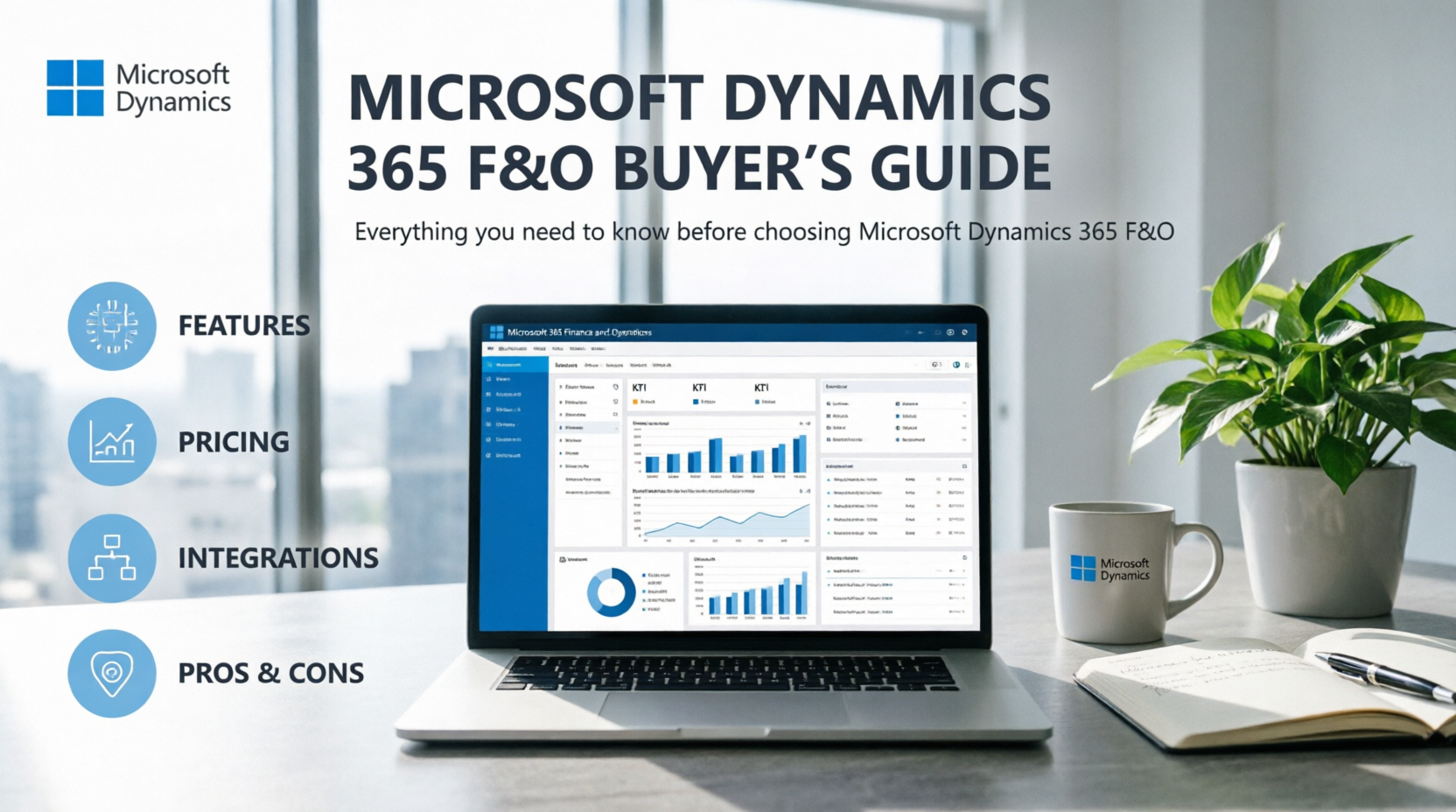
Buying Microsoft Dynamics 365 F&O: Pricing, Hidden Costs, and Implementation Traps for Enterprise Buyers
Quick answer: Microsoft Dynamics 365 Finance & Operations (D365 F&O) is the lower-cost member of the enterprise ERP triad alongside SAP S/4HANA and Oracle Fusion Cloud ERP. Buy F&O if you are a Microsoft-centric organisation, 500–10,000 users, with manufacturing, supply chain, or multi-country finance needs and an appetite for continuous-update cadence. Avoid F&O if you are below 250 users (Business Central is the right tier), need depth that exceeds Microsoft's manufacturing or process-industry coverage, or cannot fund a tier-1 SI engagement. Realistic Year-1 spend: $1M–$8M. Best deployment pattern: phased rollout, tier-1 SI with F&O specialisation, robust update governance.
Microsoft Dynamics 365 Finance & Operations sits at the lower end of the enterprise ERP tier. It's cheaper than S/4HANA or Fusion at entry, deeply integrated with the Microsoft stack (Azure, Power Platform, Microsoft 365, Power BI), and a default short-list candidate for any Microsoft-centric enterprise. This D365 F&O buyer's guide is for CFOs, CIOs, and programme directors evaluating whether F&O is the right enterprise platform for your business — or whether the lower entry cost is hiding traps that surface at scale.
If you are smaller — under 250 employees, $50M revenue — you are probably looking at Dynamics 365 Business Central, not F&O. Read NetSuite vs Dynamics 365 for the mid-market debate and Business Central buyer's guide for the BC-specific view.
What Is Microsoft Dynamics 365 F&O? (And Who's Behind It)
Dynamics 365 Finance & Operations is Microsoft's enterprise-tier cloud ERP. It evolved from Microsoft Dynamics AX (originally Axapta, acquired from Damgaard via Navision in 2002), re-platformed onto Azure and rebranded in stages through the late 2010s. Today F&O is sold as two distinct apps in the Dynamics 365 family — Dynamics 365 Finance and Dynamics 365 Supply Chain Management — though customers and the market still call the combined product "F&O" or "F&SCM."
Microsoft Corporation, headquartered in Redmond, Washington, develops the platform. F&O runs on Microsoft Azure and integrates natively with the Microsoft stack: Power BI, Power Automate, Power Apps, Microsoft 365, Teams, Dataverse, and Dynamics 365 Sales/Customer Service (CRM). That ecosystem cohesion is the platform's defining commercial advantage — and its defining lock-in.
Deployment:
- D365 F&O Cloud (SaaS) — the primary deployment model. Runs on Azure, sold per user per month, continuous update cadence.
- D365 F&O Cloud + Edge — local cloud edge for latency-sensitive scenarios (manufacturing, warehouse).
- D365 F&O On-Premise (Tier 2) — still available for highly regulated or sovereign-data customers, but Microsoft's strategic motion is cloud.
Globally, F&O is available across Microsoft Azure's region footprint — North America, EMEA (UK, EU, GCC), APAC (Australia, India, Japan, Singapore), and LATAM. Localisation covers 40+ countries with depth in UK MTD, EU VAT regimes, India GST, ZATCA (Saudi Arabia), Brazil's tax complexity, AU GST, and statutory reporting. Microsoft's multi-country breadth is strong and continuing to expand, though it varies by jurisdiction — audit per country.
Target buyer: organisations with 500–10,000 users (Microsoft also positions F&O at smaller scale, but the economics rarely work below 250 users), $100M+ revenue, Microsoft-centric technology estate, manufacturing or supply chain or multi-country finance complexity, and the appetite to manage continuous Microsoft update cycles.
Microsoft Dynamics 365 F&O Pricing in 2026
Microsoft is more transparent than SAP or Oracle on list prices but still negotiates heavily at enterprise scale. Headline rates for 2026:
| Component | Typical range (USD) | Notes |
|---|---|---|
| D365 Finance (per user/month) | $180 list | Discounted at enterprise volume |
| D365 Supply Chain Management (per user/month) | $180 list | Often bundled with Finance |
| D365 Finance + SCM (per user/month) | ~$300 list (bundle) | Most enterprise buyers take both |
| Activity / Team Member licences | $8 – $50/user/month | For light/operational users |
| Annual subscription, 500-user enterprise | $700K – $1.5M | After typical enterprise discount |
| Implementation services (SI fees) | 1.5–3x annual subscription | Tier-1 SI consultant day rates $1.5K–$3K |
| Azure infrastructure (additional capacity, sandboxes) | $150K – $700K/year | Often underestimated |
| ISV extensions and add-ons | $100K – $500K/year | Industry-specific functionality |
| Power Platform, Power BI Premium | $50K – $300K/year | Frequently essential |
The licensing complexity trap is real and specific to F&O. Microsoft sells F&O as part of the broader Dynamics 365 family, which means buyers must navigate:
- Full user licences vs Activity licences vs Team Member licences
- D365 Sales / Customer Service / Project Operations / Field Service — each separately priced
- Power Platform per-app, per-user, and per-capacity SKUs
- Dataverse storage and capacity
- Azure infrastructure for sandboxes, dev environments, and add-on services
A real enterprise F&O quote spans 10+ SKU lines. Misreading the licensing model is a common cause of post-go-live cost surprise. For the full mechanics of enterprise ERP cost structure, see our ERP cost breakdown.
Implementation Traps to Know Before You Sign
F&O implementations fail in well-understood ways. Microsoft's commercial pressure to close, the X++ customisation trap, and the continuous update cadence all create specific risks.
| Trap | Severity | Detail |
|---|---|---|
| Licensing cost stacking | High | D365 Finance starts at $180/user/month list; combining apps (Finance + SCM + Sales + Project Ops) multiplies rapidly. |
| Implementation over-budget | High | F&O implementations routinely exceed timeline and budget without strong governance. 1.5–3x scope creep is common. |
| Customisation via X++ risk | High | X++ customisations are complex, expensive to maintain, and upgrade-sensitive. Every X++ change is a future liability. |
| Update cadence disruption | High | Continuous cloud updates (8+ per year) can break customisations and require sustained regression testing. |
| ISV extension conflicts | High | Multiple ISV extensions in the same environment create conflict and support gaps. |
| SI dependency | High | Large F&O implementations require tier-1 system integrators at enterprise rates. |
| Manufacturing depth vs S/4HANA | Medium | F&O is strong in discrete manufacturing but lighter than S/4HANA in process industries and complex supply chain. |
| Azure infrastructure lock-in | Medium | Runs on Azure. Infrastructure costs are additional, ongoing, and Microsoft-controlled. |
| Power Platform sprawl | Medium | Citizen-developed apps and flows accumulate quickly; governance is rarely funded upfront. |
| Multi-country localisation depth | Medium | Coverage is broad but uneven by country. Audit per jurisdiction. |
| Dual-Write / CRM integration complexity | Medium | The F&O-CRM integration (Dual-Write) is functional but adds operational overhead. |
| Industry edge cases | Medium | F&O handles mainstream verticals well. Niche industries (chemicals, pharma, regulated services) may need substantial ISV layering or favour S/4HANA. |
These trap patterns repeat across F&O implementations. Which ones will hit your deployment depends on your scope, SI choice, and governance maturity.
Partner / SI Questions That Matter
The F&O SI ecosystem spans Big 4 (Deloitte, KPMG, PwC, EY), tier-1 SIs (Accenture, Avanade, Capgemini, Cognizant, HCL, Infosys, TCS), and Microsoft-specialist firms (Hitachi Solutions, Sikich, RSM, Columbus, To-Increase, DXC). Avanade — the Microsoft-Accenture joint venture — is often Microsoft's preferred named partner at enterprise scale.
Pressure-test the partner with these:
- D365 F&O is sold and implemented through Microsoft partners. What is your Microsoft Solutions Partner designation in Business Applications, your F&O specialisation, and how many active F&O clients do you support at our scale? Look for current Solutions Partner status with advanced specialisation, not historical Gold partner credentials.
- X++ customisations are expensive and upgrade-sensitive. What is your customisation governance framework — when do you allow X++ versus extensions versus Power Platform? The honest answer involves a hierarchy: configure first, extend via Power Platform second, X++ only as last resort with documented business case.
- How do you manage the continuous update cycle? What does your regression testing process look like for each release? Microsoft pushes 8+ updates per year. Sustained QA capability is essential.
- What is your approach to ISV extensions — how do you validate compatibility before recommending them, and what is your process if two ISVs conflict post-go-live?
- Who specifically will lead our project? What is their certification level, their last three reference projects at our scale, and how long they have been at your firm?
- What does a typical F&O implementation for our size and industry cost, and what are the most common scope-creep triggers? A partner with no honest scope-creep narrative has not done enough delivery.
- What is your post-go-live managed services offering for F&O updates, ISV maintenance, and Power Platform governance?
For the broader debate on partner vs vendor delivery, see partner vs vendor direct implementation.
Demo Requests to Insist On
Generic F&O demos showcase the suite at its best. Insist on live builds against your data and scenarios.
- Financial Period Close workspace. Show the task management and workflow for a multi-entity close, end-to-end.
- Power BI embedded analytics on a live F&O dataset. Build a financial report from scratch in front of you.
- A customisation deployed via X++. Show the full development, test, build, and deployment process — including a sandbox-to-production promotion.
- Dual-Write integration between F&O and D365 Sales (CRM). Demonstrate data flowing both ways with conflict-resolution scenarios.
- The update cycle management. Show how a Microsoft release is tested in a sandbox before production, what the rollback looks like, and how customisations behave.
- Multi-country e-invoicing and statutory reporting. Demonstrate compliance for at least two of: UK MTD, EU VAT, India GST, ZATCA, Brazil NFe.
- Manufacturing and supply chain depth. Show production order lifecycle, capacity planning, and procurement-to-pay for an industry comparable to yours.
Recommended Ecosystem Tools
F&O covers a lot, but every real enterprise deployment ends up with a layered stack. Budget for these.
| Tool | What it does | Gap it fills |
|---|---|---|
| Power BI | Self-service BI and executive dashboards | F&O has embedded Power BI, but meaningful enterprise reports require significant data modelling |
| Jet Reports / Solver | Excel-based financial reporting and FP&A | F&O's native financial reporting is complex; Jet/Solver add accessible Excel-based reporting |
| Concur (SAP) | Travel and expense management | F&O has expense management but Concur often wins on mobile UX and policy depth |
| Vertex / Avalara | Sales tax automation | F&O's tax engine is insufficient for US multi-state indirect tax complexity |
| Esker / Tungsten | AP automation and invoice management | F&O's AP processing is manual; these add AI-driven invoice capture and straight-through processing |
| Celonis | Process mining on F&O event logs | Surfaces deviations in procure-to-pay, order-to-cash, and financial close |
| Riskonnect / Resolver | GRC and audit management | F&O has limited native GRC; these add risk management and SOX controls frameworks |
| Power Automate | Workflow automation connecting F&O to Microsoft 365 | Extends F&O approvals and notifications into Teams, Outlook, and SharePoint |
| To-Increase / Dynaway | Industry ISV extensions for manufacturing, asset management | Fill specific vertical gaps in F&O standard functionality |
| LCS (Lifecycle Services) | Microsoft's project, environment, and update management | Native Microsoft tool — essential but underused by inexperienced SIs |
Who Microsoft Dynamics 365 F&O Is For (and Who It Isn't)
| Profile | F&O fit | Rationale |
|---|---|---|
| Microsoft-centric enterprise, 500+ users | Strong | Tight integration with Azure, M365, Power Platform, Teams pays off |
| Discrete manufacturing, multi-country | Strong | F&O manufacturing depth is mature; supply chain breadth is strong |
| Distribution and wholesale | Strong | WMS, advanced inventory, EDI integration are mature |
| Retail and commerce | Strong | D365 Commerce (separate but integrated) covers POS and omnichannel |
| Services-heavy organisation | Strong with Project Operations | F&O + D365 Project Operations covers professional services well |
| Process industries (chemicals, pharma, oil & gas) | Watch | S/4HANA generally has deeper process-industry verticals |
| Public sector and regulated finance | Strong with caveats | Microsoft has GCC clouds (US Government, UK Sovereign) for sensitive workloads |
| Sub-250 users | Weak | Business Central is the right tier |
| Heavy reliance on non-Microsoft stack | Watch | Value compounds with Microsoft adjacency; less compelling for AWS/GCP-first shops |
| Asset-intensive industries (mining, utilities) | Watch | Possible with ISV extensions; JD Edwards or Infor often deeper natively |
For the broader debate on whether a major enterprise ERP or a niche industry platform fits, see major ERP vendor vs niche ERP.
Microsoft Dynamics 365 F&O vs Alternatives
At enterprise scale, F&O competes with SAP S/4HANA, Oracle Fusion Cloud ERP, Workday Financials, and Infor CloudSuite. At the lower end of the enterprise tier, it also competes with NetSuite — read NetSuite vs Dynamics 365 for that comparison.
- F&O vs S/4HANA: F&O is cheaper at entry, stronger in Microsoft-centric environments, and lighter to implement. S/4HANA has deeper industry verticals (manufacturing, process industries) and stronger global localisation in regulated markets. S/4HANA wins at the largest scale and most complex multi-country deployments; F&O wins on Microsoft-stack cohesion and lower total cost up to ~5,000 users.
- F&O vs Oracle Fusion: Fusion is more enterprise-pure, more SaaS-mature, and more expensive. F&O is cheaper, more Microsoft-integrated, and slightly lighter. Both are credible at enterprise scale; the choice usually comes down to existing technology estate and SI ecosystem in your region.
- F&O vs JD Edwards: JDE is in maintenance mode. For a new buyer, F&O is the modern cloud choice; JDE is the legacy on-premise option. Read JD Edwards buyer's guide for the strategic context.
- F&O vs Business Central: Different tiers. F&O is enterprise (500+ users); BC is mid-market (75–500 users). No upgrade path between them — moving from BC to F&O is a reimplementation.
- Cloud vs on-premise: F&O is overwhelmingly cloud. On-premise (Tier 2) exists for regulated workloads. Read our cloud vs on-premise ERP guide for the trade-offs.
For capabilities and fit, see the Dynamics 365 F&O platform profile. Compare it head-to-head: Dynamics 365 F&O vs SAP S/4HANA, Dynamics 365 F&O vs JD Edwards, Dynamics 365 F&O vs Oracle Fusion Cloud.
Frequently Asked Questions
How much does Microsoft Dynamics 365 F&O cost?
D365 Finance list price is $180/user/month, with D365 Supply Chain Management priced similarly. Most enterprise buyers take both, often bundled at around $300/user/month, with enterprise discounts of 15–35% at scale. A 500-user enterprise typically spends $700K–$1.5M annually on F&O subscription, with implementation services at 1.5–3x that figure. Azure infrastructure, ISV extensions, Power Platform, and additional D365 apps (Sales, Customer Service, Project Operations) add another 20–50% to the total subscription line. Real total Year-1 spend at enterprise scale typically lands $1M–$8M.
Who owns Microsoft Dynamics 365 F&O?
Microsoft Corporation, the US technology giant headquartered in Redmond, Washington. F&O is part of the Dynamics 365 family, which spans Finance, Supply Chain Management, Sales, Customer Service, Field Service, Project Operations, Business Central, and others. Microsoft also owns the broader Power Platform, Azure cloud infrastructure, Microsoft 365 productivity suite, and Dataverse data platform that integrate with F&O.
How long does a Dynamics 365 F&O implementation take?
Greenfield enterprise F&O implementations typically run 12–24 months for a single-region deployment with finance, supply chain, and a defined manufacturing or distribution scope. Multi-country, multi-entity rollouts commonly run 24–48 months across waves. Anyone promising sub-9-month enterprise F&O go-live with full finance and supply chain is either selling a thin scope or building you a programme that will miss the date. For the underlying mechanics of enterprise ERP timelines, see our implementation timeline guide.
Can we implement D365 F&O ourselves without a partner?
In practice, no. Microsoft sells F&O exclusively through partners and partner-led implementations are the rule for enterprise scope. Even Microsoft Consulting Services typically engages alongside a tier-1 SI rather than as the sole delivery party. F&O implementations require certified consultants with deep experience in F&O configuration, X++, Power Platform integration, Lifecycle Services (LCS), and update governance. Self-delivery without SI support is a recipe for a missed go-live.
What is the difference between D365 F&O and D365 Business Central?
Different tiers, different products. F&O targets 500+ user enterprises with $100M+ revenue. Business Central targets 10–250 user mid-market businesses. F&O has deeper manufacturing, supply chain, and multi-entity capability; BC is simpler and cheaper. They share the Dynamics 365 brand but have different codebases, different data models, and no upgrade path. Moving from BC to F&O is a full reimplementation, not a migration.
Is D365 F&O the same as Dynamics AX?
Functionally yes — F&O is the cloud-evolved descendant of Microsoft Dynamics AX (originally Damgaard Axapta). Microsoft re-platformed AX onto Azure and rebranded through the late 2010s. AX 2012 R3 is the last on-premise version; everything since has been cloud-first. Customers still occasionally call it "AX" or "Dynamics AX," and many SIs market F&O expertise as continuous with their AX history.
How do D365 F&O updates work?
Microsoft pushes 8+ updates per year via Lifecycle Services (LCS). Updates are mandatory — customers cannot skip — but Microsoft provides a sandbox environment for regression testing each release before it reaches production. Sustained QA and regression-testing capability is essential. Most enterprises budget $200K–$700K per year for a dedicated update-management function. Underfunding this is one of the most common post-go-live failures.
What are the main alternatives to Dynamics 365 F&O?
At enterprise scale: SAP S/4HANA Cloud, Oracle Fusion Cloud ERP, Workday Financials, and Infor CloudSuite. At the lower end of enterprise scope, NetSuite is sometimes considered. The choice between F&O and its peers usually turns on existing technology estate (Microsoft-centric organisations gravitate to F&O), industry depth (S/4HANA wins manufacturing and process; Fusion wins services), and SI ecosystem in your region.
How ERPLenz Can Help
D365 F&O is rarely the wrong answer for a Microsoft-centric enterprise — but "rarely wrong" and "definitively right" are different things. The buyers who avoid the eight-figure scope shocks are the ones who walk in with a structured pre-selection evaluation of their own industry depth requirements, multi-country complexity, customisation appetite, and existing Microsoft estate — versus the S/4HANA and Fusion alternatives.
ERPLenz runs that pre-selection diligence. Our 116-point assessment surfaces the variables that determine fit between your business and F&O specifically — versus S/4HANA, Fusion, and the rest of the enterprise field — and produces a calibrated 5-year TCO, a ranked shortlist of 3 platforms with fit scores, risk flags per platform, and (in the Deep Report) SI recommendations in your region with proven F&O delivery in your industry.
The vendors above suit different patterns. Which one fits your business depends on the 100+ variables a proper evaluation surfaces. Use this article as the floor of your evaluation, not the ceiling.
Begin your free ERP assessment →
Built by consultants who have scoped, rescued, and renegotiated F&O programmes across UK, EU, APAC, and the Americas — vendor-agnostic on principle because Microsoft has enough advocates already.