Buying Oracle Fusion Cloud ERP: Pricing, Hidden Costs, and Implementation Traps for Enterprise Buyers in 2026
Quick answer: Oracle Fusion Cloud ERP is one of three credible enterprise platforms (alongside SAP S/4HANA and Dynamics 365 F&O) for organisations above 500 users running global finance, procurement, and HR on a single cloud stack. Buy it if you have 500+ users, prefer a modern cloud-only architecture, can absorb quarterly mandatory updates, and have an existing Oracle estate or services-heavy operating model. Avoid it below ~300 users (NetSuite is Oracle's mid-market answer) or if your SI bench is thin. Realistic Year-1 spend: $1.5M–$10M+. Best deployment pattern: phased rollout, Oracle Soar migration tooling for EBS/JDE customers, tier-1 SI with Fusion specialisation.
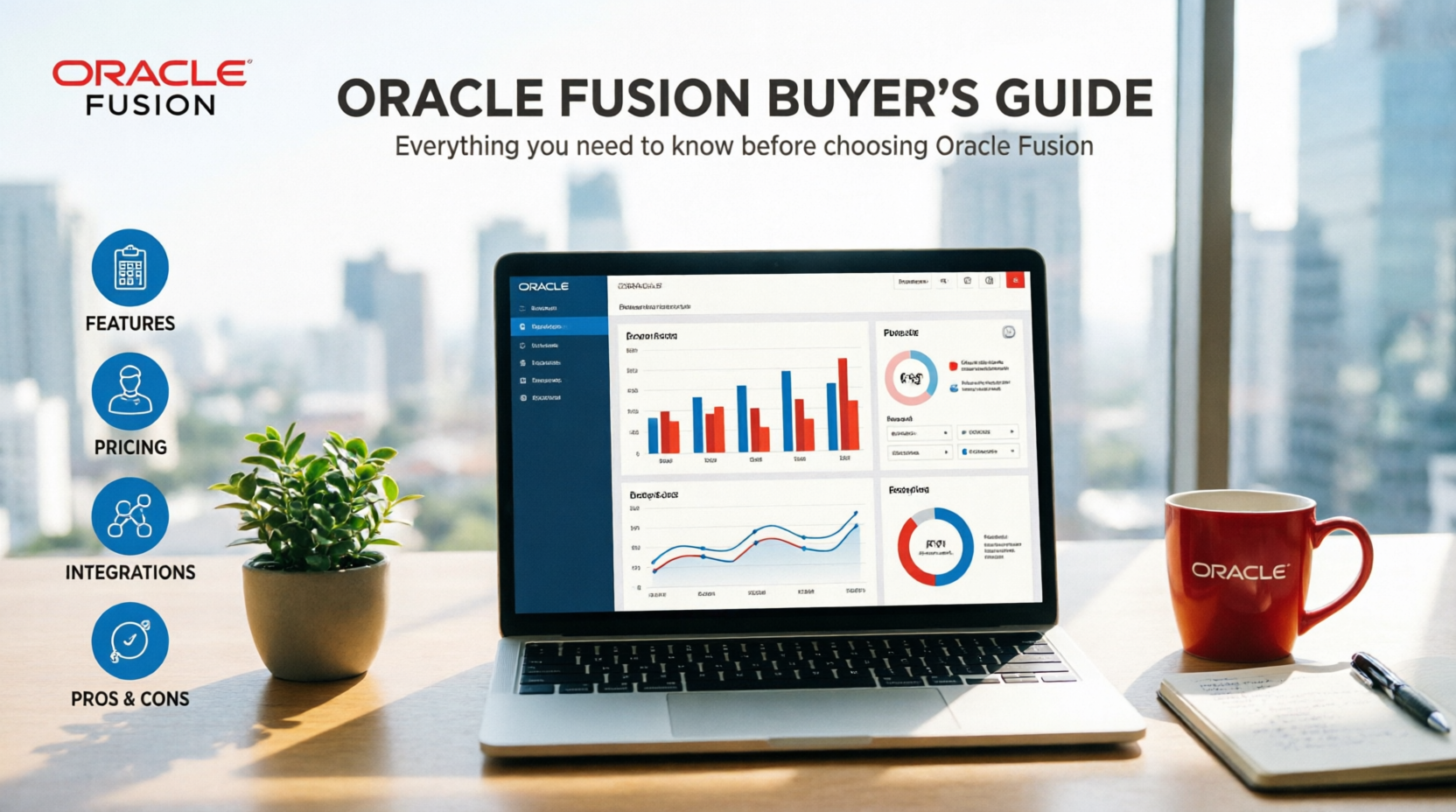
Oracle Fusion Cloud ERP is Oracle's strategic enterprise ERP. It is Oracle's bet on what cloud ERP looks like for the next 20 years — fully SaaS, quarterly innovation cadence, AI embedded everywhere, no on-premise option. Every enterprise shortlist that includes SAP S/4HANA should include Fusion. This Oracle Fusion buyer's guide gives CFOs, CIOs, and programme directors a blunt view of the pricing dynamics, traps, and SI decisions that decide whether your Fusion programme stabilises in 18 months or grinds for 36+.
If you currently run Oracle E-Business Suite (EBS), JD Edwards, or PeopleSoft, Oracle's Soar programme is actively migrating customers to Fusion. The clock is not as loud as SAP ECC's 2027 maintenance cliff, but the strategic direction is unambiguous.
What Is Oracle Fusion Cloud ERP? (And Who's Behind It)
Oracle Fusion Cloud ERP is Oracle's modern, SaaS-native enterprise ERP, built fresh starting in the mid-2000s rather than being a re-platform of an older product. It is part of the broader Oracle Cloud Applications suite, which also includes Oracle Fusion HCM, Oracle Fusion SCM, Oracle Fusion CX, and Oracle EPM Cloud. The data model is shared across the suite, which is one of Fusion's structural advantages over competitors that have stitched together acquired products.
Oracle Corporation, headquartered in Austin, Texas (relocated from Redwood Shores), develops and operates the platform. Oracle owns the entire stack — applications, the Oracle Autonomous Database underneath, Oracle Cloud Infrastructure (OCI) it runs on, and the integration and analytics tools (OIC and OAC) that surround it. That vertical integration is both a strength and a source of vendor lock-in.
Deployment is cloud-only:
- Oracle Fusion Cloud ERP (SaaS) — the only deployment option. Multi-tenant SaaS on Oracle Cloud Infrastructure (OCI).
- Oracle Cloud Infrastructure (OCI) — the underlying cloud. You don't choose AWS, Azure, or GCP for Fusion. Oracle's own cloud is the deployment substrate.
- No on-premise option — Oracle's on-premise ERP is E-Business Suite (EBS) or JD Edwards, both of which Oracle is migrating to Fusion.
Globally, Fusion is available in most regions Oracle operates — North America, EMEA (UK, EU, GCC), APAC (Australia, India, Singapore, Japan), and LATAM. Localisation covers UK MTD, EU VAT, India GST, ZATCA, Brazil's complex tax regime, and 30+ statutory jurisdictions. For multi-country deployments, Fusion's localisation depth is strong but not always as deep as S/4HANA in highly regulated EU/APAC markets — diligence is essential per country.
Target buyer: organisations with 500+ users (Oracle's own positioning suggests 300–500 minimum to be practical), $100M+ revenue, multi-country operations, services-heavy or asset-heavy operating models, and an appetite for quarterly cloud innovation cadence.
Oracle Fusion Cloud ERP Pricing in 2026
Like SAP, Oracle does not publish list prices for Fusion. Every contract is negotiated. Oracle's pricing model is per user per module, with steep discounts for multi-year, multi-module, and multi-cloud commitments. The headline rates buyers see — $175–$300/user/month for ERP, with HCM and SCM priced similarly — are starting points, not endpoints.
Realistic 2026 enterprise bands:
| Component | Typical range (USD) | Notes |
|---|---|---|
| Fusion ERP subscription (per user/month) | $175 – $300 | List rate; expect 20–50% discount at enterprise volume |
| Annual subscription, 500-user enterprise | $500K – $1.5M | Highly dependent on modules and term |
| Annual subscription, 2,000-user enterprise | $2M – $6M | Multi-pillar discount drives unit cost down |
| Implementation services (SI fees) | 1.5–3x annual subscription | Tier-1 SI consultant day rates $1.5K–$3K |
| Ancillary cloud (OIC, OAC, OGL, EPM) | $200K – $1.5M/year | Adds 15–30% to base subscription |
| 100-user, 3-year TCO | $830K – $1.7M | Reference band from Oracle pricing analyses |
| Quarterly update regression testing (annual cost) | $200K – $800K | Often overlooked; bake it in |
Oracle's commercial behaviour is notoriously sharp at renewal. Lock in renewal rates, ramp schedules, and ULA (Unlimited License Agreement) exit terms at initial signing. Buyers who do not negotiate renewal terms upfront frequently absorb 20–40% increases at renewal. For the full mechanics of enterprise ERP cost structure, see our ERP cost breakdown.
Negotiated pricing opacity is the universal enterprise dynamic. Independent benchmarking — knowing what comparable buyers in your sector are paying — is the single biggest lever you have.
Implementation Traps to Know Before You Sign
Fusion implementations are among the most complex in the enterprise ERP market — Oracle's own customer base and analyst commentary confirms this. The traps below repeat across deployments. Which ones will hit your programme depends on your scope, SI choice, and governance.
| Trap | Severity | Detail |
|---|---|---|
| Cost at top of market | High | $175–300/user/month list; 100-user 3-year TCO typically $830K–$1.7M; enterprise scale pushes into eight figures. |
| Implementation complexity | High | Among the most complex ERP implementations in the market. Under-resourcing equals failure. |
| Quarterly mandatory updates | High | Oracle pushes quarterly updates. Every release requires regression testing. No skipping. |
| Ancillary service cost stacking | High | OIC (integration), OAC (analytics), OGL (learning), EPM (planning) all add separate subscription costs. |
| Smaller SI talent pool | High | Fewer Fusion-certified partners than SAP. Big 4 and tier-1 SIs dominate; bench depth varies. |
| Minimum 300–500 users | High | Not practical below this scale. NetSuite is Oracle's mid-market answer. |
| Configuration vs customisation rigidity | Medium | Fusion is configurable, but personalisations live within Oracle's extensibility framework — not free-form code. |
| Quarterly update regression burden | Medium | Customers underestimate ongoing test cost; budget $200K–$800K/year for a sustained regression capability. |
| UI complexity vs Workday/Dynamics | Medium | UX is more complex than Workday or D365; training and change management costs are higher. |
| Multi-pillar tie-in | Medium | Fusion's value compounds across ERP, HCM, SCM. Buying only ERP loses commercial leverage and architectural elegance. |
| Data residency | Medium | No on-premise option. For sovereignty-sensitive industries (defence, some GCC, some EU public sector), this may be a blocker. |
| Soar migration scope (for EBS/JDE customers) | Medium | Oracle's tooling has matured but migration from legacy Oracle products is still a multi-year programme. |
The pattern: Fusion's traps are concentrated in commercial structure (cost stacking, renewal leverage), governance (update cadence, scope creep), and SI capability. None are unique to Oracle — they show up at SAP and Microsoft too — but Fusion's quarterly update cadence makes them sharper.
Partner / SI Questions That Matter
The Fusion SI ecosystem is narrower than SAP's. Big 4 (Deloitte, KPMG, PwC, EY), tier-1 SIs (Accenture, Cognizant, Capgemini, Infosys, TCS, Wipro), and Oracle-specialist firms (Mastek, KPI Partners, Inspirage — many of these have been acquired) dominate. Bench quality varies; A-teams are reserved for largest clients.
Pressure-test the partner with these:
- Given the narrow pool of Fusion-certified SIs, who specifically are the named consultants on our project? What is their Fusion certification level, their last three reference projects, and their tenure at your firm? A specific answer matters. "We'll allocate the team after signing" is a red flag.
- Oracle pushes mandatory quarterly updates. What is your regression testing methodology, and what SLAs govern post-update validation? Good answers describe a sustained QA capability, not a one-off project asset.
- What ancillary Oracle services are you recommending — OIC, OAC, OGL, EPM — and what do those add to total annual cost? A partner who recommends the full stack from day one is either bundling for margin or has not done a real fit-gap.
- What is your implementation governance model? Specifically, how do you control scope creep on a Fusion project? Scope creep is the number-one killer of Fusion programmes. Look for change-control gates, joint executive steering, and weekly scope-impact reporting.
- What is your experience with Oracle Soar for migrating clients from EBS or JDE? Show a reference at our scale. Migration-experienced partners are scarcer and more valuable than greenfield-only partners if you are coming from legacy Oracle.
- What is your customisation governance framework? When do you allow personalisation versus extension via OIC and PaaS? If they cannot articulate the boundary, they will build technical debt.
For broader thinking on partner vs vendor delivery, see partner vs vendor direct implementation.
Demo Requests to Insist On
Stock Fusion demos showcase the suite at its best. Insist on live builds, live data, and your scenarios.
- Multi-entity consolidation with intercompany eliminations. Demo the close process for a three-subsidiary, multi-currency consolidation. Show the actual time elapsed.
- Oracle Analytics Cloud (OAC) integrated with Fusion. Build a custom executive dashboard from live Fusion data, in front of you, in under 30 minutes.
- Oracle Integration Cloud (OIC) building a real integration. Watch the SI build a working integration between Fusion and a specified third-party system during the demo.
- The quarterly update process. Demonstrate how Oracle's update sandbox works, how the SI validates a release before production, and what the rollback path looks like.
- AI capabilities in Fusion. Show the accounts payable AI for invoice processing, anomaly detection, and matching exceptions.
- Multi-country e-invoicing and statutory reporting. Demonstrate compliance for at least two of: UK MTD, EU VAT, India GST, ZATCA, Brazil NFe.
Recommended Ecosystem Tools
Even with Oracle's vertically integrated stack, real Fusion deployments end up with a layer of third-party tools. Budget for them.
| Tool | What it does | Gap it fills |
|---|---|---|
| Oracle Analytics Cloud (OAC) | Enterprise BI, planning, and self-service analytics on Fusion data | Embedded reporting is strong, but OAC adds governed self-service and predictive analytics |
| Oracle Integration Cloud (OIC) | Oracle's own iPaaS for connecting Fusion to external systems | Fusion APIs are powerful but complex; OIC adds pre-built adapters and orchestration |
| Concur (SAP) | Travel and expense management | Fusion has T&E but Concur often wins on mobile UX and policy depth |
| Vertex | Tax determination engine | Native tax is insufficient for complex US multi-state and global indirect tax |
| OpenText / Hyland | Enterprise content management and AP document automation | Fusion has document handling but enterprise content management needs depth |
| Celonis | Process mining on Fusion event logs | Identifies execution deviations across P2P, O2C, and financial close |
| Workiva | Financial reporting, SEC filings, SOX documentation | Strong complement for public companies needing audit-grade reporting automation |
| BlackLine | Account reconciliation and close management | Fusion's close is powerful but BlackLine adds reconciliation templates and task management at scale |
Who Oracle Fusion Cloud ERP Is For (and Who It Isn't)
| Profile | Fusion fit | Rationale |
|---|---|---|
| Services-heavy organisation (consulting, agency, professional services) | Strong | Fusion's project and time-to-cash flows are mature |
| Existing Oracle EBS, JDE, or PeopleSoft customer | Strong | Oracle Soar tooling and migration path align |
| Global enterprise, 1,000+ users | Strong | Multi-pillar suite and quarterly innovation cadence work at scale |
| Public-sector and regulated industries | Strong with caveats | Cloud-only may conflict with data sovereignty in specific jurisdictions |
| Financial services | Strong | Mature finance, treasury, and risk; deep ERP and EPM integration |
| Heavy discrete manufacturing | Watch | S/4HANA still has deeper manufacturing verticals |
| Sub-300 users | Weak | NetSuite is Oracle's mid-market platform; Fusion is not practical at this scale |
| Need go-live in under 12 months at enterprise scope | Weak | Greenfield single-pillar deployments can hit 9–12 months; full suite is longer |
| On-premise mandatory | Weak | No on-premise option exists |
For the broader debate on whether a major enterprise ERP or a niche industry platform fits, see major ERP vendor vs niche ERP.
Oracle Fusion Cloud ERP vs Alternatives
The realistic enterprise shortlist usually includes Fusion, SAP S/4HANA, Dynamics 365 F&O, and sometimes Workday Financials or Infor CloudSuite.
- Fusion vs S/4HANA: Fusion wins on services industries, modern UI, faster greenfield deployments, quarterly innovation cadence, and unified data model across the suite. S/4HANA wins on manufacturing, process industries, supply chain depth, and existing-customer migration.
- Fusion vs D365 F&O: Fusion is more enterprise-scale, more SaaS-pure, and more expensive. F&O is stronger in Microsoft-centric environments and at the lower end of the enterprise tier.
- Fusion vs JD Edwards: Both are Oracle products. JDE is in maintenance mode; Oracle is migrating JDE customers to Fusion via Soar. For new buyers, Fusion is the only credible Oracle enterprise choice.
- Fusion vs NetSuite: Both are Oracle, but they target different tiers. NetSuite is mid-market. Fusion is enterprise. The boundary is roughly 300–500 users; if you are below, NetSuite. Above, Fusion.
- Cloud vs on-premise: Fusion is cloud-only. For sovereignty or air-gapped requirements, read our cloud vs on-premise ERP guide.
For capabilities and fit, see the Oracle Fusion Cloud platform profile. Compare it head-to-head: Oracle Fusion Cloud vs SAP S/4HANA, Oracle Fusion Cloud vs JD Edwards, Oracle Fusion Cloud vs Dynamics 365 F&O, Oracle Fusion Cloud vs NetSuite.
Frequently Asked Questions
How much does Oracle Fusion Cloud ERP cost?
List rates run $175–$300 per user per month for the core ERP module, with negotiated discounts of 20–50% at enterprise volume. A 500-user enterprise typically spends $500K–$1.5M annually on Fusion subscription, with implementation 1.5–3x that figure and ancillary services (OIC, OAC, EPM) adding another 15–30%. A 100-user, 3-year TCO commonly lands at $830K–$1.7M. Like SAP, Oracle does not publish list prices, so independent benchmarking against comparable buyers is the most reliable input to negotiation.
Who owns Oracle Fusion Cloud ERP?
Oracle Corporation, the US enterprise software giant headquartered in Austin, Texas (relocated from Redwood Shores, California). Oracle owns Fusion outright — applications, the underlying Oracle Autonomous Database, the Oracle Cloud Infrastructure (OCI) it runs on, and the integration and analytics tools (OIC, OAC, EPM) that surround it. Oracle also owns NetSuite (mid-market ERP), JD Edwards (legacy enterprise ERP, in maintenance mode), and E-Business Suite (legacy on-premise ERP).
How long does an Oracle Fusion implementation take?
Greenfield single-pillar deployments (ERP only) typically run 9–18 months for mid-sized enterprises. Multi-pillar greenfield (ERP + HCM + SCM) commonly runs 18–30 months. Migrations from EBS, JDE, or PeopleSoft via Oracle Soar run 24–48 months depending on scope, geography, and customisation. Multi-country rollouts add 12–24 months on top. Anyone promising sub-6-month enterprise Fusion deployment is either selling a thin scope or missing the go-live. See our implementation timeline guide.
Can we migrate from Oracle E-Business Suite to Fusion?
Yes — Oracle's Soar programme is the migration pathway. EBS-to-Fusion is the most common Oracle modernisation today. The programme typically involves greenfield re-implementation of Fusion (not a technical lift-and-shift), parallel running of EBS during cutover, and a 24–48 month timeline. Oracle Soar tooling has matured significantly. Buyers should expect to redesign processes during migration rather than replicating EBS configuration in Fusion.
What is the difference between Oracle Fusion and NetSuite?
Both are Oracle, but they target different tiers. NetSuite is mid-market ERP (75–500 employees, $10M–$100M revenue). Fusion is enterprise ERP (500+ users, $100M+ revenue). They share Oracle ownership but no shared codebase, no shared data model, and no upgrade path. Oracle deliberately keeps them separate. If you are considering both, you are probably looking in the wrong tier — pick one based on your actual scale.
Is Oracle Fusion better than SAP S/4HANA?
Neither is universally better. Fusion wins on services-heavy organisations, modern UX, quarterly innovation cadence, and unified data model. S/4HANA wins on manufacturing, process industries, supply chain depth, and global localisation breadth. The right choice depends on industry, existing technology estate, customisation appetite, and SI ecosystem in your region. The honest answer is both are credible at enterprise scale and the differentiation lives in the details of your specific business.
Can we implement Oracle Fusion ourselves without a system integrator?
For enterprise scope, no. Fusion implementations require Oracle-certified consultants with deep experience in Fusion configuration, OIC integration, OAC analytics, and quarterly update governance. Even Oracle's own customer-led programmes use SI capability for build, integration, and cutover. Self-delivery without SI support is a recipe for a missed go-live.
Do Oracle Fusion quarterly updates break things?
They can, and the only way to manage the risk is a sustained regression-testing capability. Oracle pushes quarterly updates to every Fusion tenant; you cannot skip releases. Each release requires regression testing of customisations, integrations, and personalisations. Most enterprises absorb $200K–$800K per year on a dedicated QA/regression function. Underfunding this is one of the most common post-go-live failures.
How ERPLenz Can Help
Oracle Fusion decisions are commercial as much as technical. The buyers who negotiate well, choose well, and avoid the eight-figure scope shocks are the ones who walk in with a structured pre-selection evaluation of their own scale, industry, geographic footprint, and existing Oracle estate — versus the SAP S/4HANA and Dynamics 365 F&O alternatives.
ERPLenz runs that pre-selection diligence. Our 116-point assessment surfaces the variables that determine fit between your business and Fusion specifically — versus S/4HANA, F&O, and the rest of the enterprise field — and produces a calibrated 5-year TCO, a ranked shortlist of 3 platforms with fit scores, risk flags per platform, and (in the Deep Report) SI recommendations in your region with proven Fusion delivery in your industry.
These trap patterns repeat across many Fusion implementations. Which ones will hit your deployment is what a calibrated assessment surfaces. Use this article as the floor of your evaluation, not the ceiling.
Built by consultants who have negotiated, scoped, and rescued Oracle Fusion programmes — vendor-agnostic by design, because we get paid by buyers, never by Oracle.