Buying SAP S/4HANA Cloud: Pricing, Hidden Costs, and Implementation Traps to Know Before You Sign
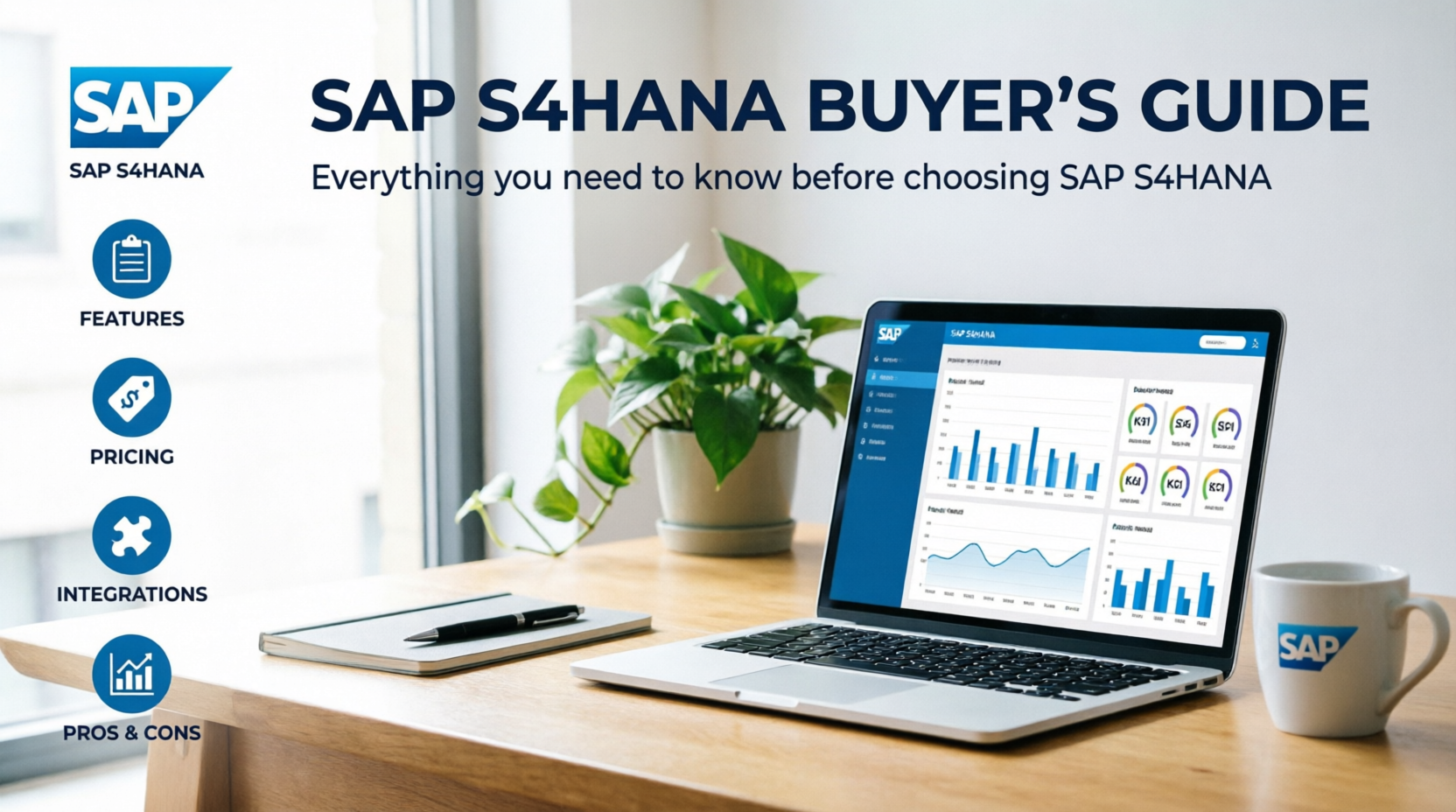
Quick answer: SAP S/4HANA Cloud is the dominant enterprise ERP for global, process-heavy organisations running multi-country finance, supply chain, and manufacturing on a single platform. Buy it if you already run SAP ECC, operate in 5+ countries with regulated industries, or need deep process integration at $100M+ revenue. Avoid it if you have under 500 employees, want a sub-12-month deployment, or cannot fund a Big 4 / tier-1 SI programme. Realistic Year-1 spend: $1.5M–$15M+ depending on scope. Best deployment pattern: RISE with SAP, multi-phase rollout led by a top-tier SI.
SAP S/4HANA Cloud is the platform large enterprises end up evaluating whether or not they want to. If you run SAP ECC, your migration clock is ticking — mainstream maintenance ends in 2027 with extended support to 2030. If you don't run SAP today, S/4HANA still shows up on every enterprise shortlist alongside Oracle Fusion Cloud ERP and Microsoft Dynamics 365 F&O. This SAP S/4HANA buyer's guide gives CFOs, CIOs, and programme directors a blunt view of the pricing, traps, and partner decisions that determine whether your S/4HANA programme succeeds or quietly burns $20M.
This is a programme, not an implementation. Frame it that way from day one or expect the classic enterprise failure pattern: scope drift, SI churn, executive disengagement, go-live slippage.
What Is SAP S/4HANA Cloud? (And Who's Behind It)
SAP S/4HANA is SAP's flagship next-generation ERP, built on the in-memory HANA database. It replaces SAP's legacy ERP product (ECC, formerly R/3) and is positioned as SAP's strategic platform for the next two decades. SAP SE, headquartered in Walldorf, Germany, develops the product. It serves roughly two-thirds of the Fortune 500 either through ECC, S/4HANA, or both.
S/4HANA Cloud comes in three primary deployment models, and which one you choose materially changes pricing, customisation freedom, and upgrade obligations:
- RISE with SAP — SAP-managed cloud subscription bundling licence, infrastructure, and basic services. Public or private cloud variants. Most common path for enterprises migrating from ECC.
- GROW with SAP — SAP's mid-market public-cloud SKU for greenfield buyers with simpler scope. Less customisation freedom.
- S/4HANA Private Cloud Edition (PCE) — single-tenant private cloud, run by SAP or a hyperscaler, with more customisation latitude (ABAP allowed in the "extensibility cabinet").
- S/4HANA On-Premise — still sold, still supported, mostly to highly regulated or sovereign-data customers.
Globally, S/4HANA is available everywhere SAP operates — UK, EU, US, Australia, India, GCC, LATAM, Japan, China — with localisation packs for tax, statutory reporting, and e-invoicing covering 40+ countries (UK MTD, EU VAT, India GST, ZATCA, SAF-T, France's Factur-X, and others). This breadth is one of the reasons S/4HANA wins at multinationals; few competitors offer comparable depth across regulated jurisdictions.
Target buyer: organisations with 500+ employees and $100M+ revenue, multi-country operations, complex manufacturing or process industries, regulated reporting requirements, and the appetite to fund a multi-year transformation programme.
SAP S/4HANA Pricing in 2026
SAP does not publish list prices. Every contract is negotiated, and pricing depends on industry, FUE (Full User Equivalent) counts, modules, deployment model, and your willingness to commit to a multi-year RISE contract. Anyone who quotes you a "standard S/4HANA price" without diagnosing your scope is making it up.
That said, here are realistic bands enterprise buyers should expect in 2026:
| Component | Typical range (USD) | Notes |
|---|---|---|
| Annual subscription (RISE) | $250K – $5M+ | Driven by FUE count, modules, industry add-ons |
| GROW with SAP (mid-market SKU) | $100K – $500K/year | Constrained scope, public cloud only |
| Implementation services (SI fees) | 2–5x annual subscription | Big 4 and tier-1 SIs at $1.5K–$3K per consultant-day |
| ECC-to-S/4HANA migration programme | $3M – $50M+ | Multi-year, multi-country programmes |
| Hypercare and run | $300K – $2M/year | Ongoing managed services |
| Ancillary cloud (SAC, Ariba, Concur, BTP) | $100K – $1M+/year | Adds 20–40% to base subscription |
For the underlying mechanics of enterprise ERP cost structure — licence, implementation, integration, infrastructure, change management — see our full ERP cost breakdown. The pattern at the enterprise tier is consistent: licence is 15–25% of true 5-year TCO; everything else is people, integration, and change.
Negotiated pricing opacity is the single most important commercial dynamic. SAP's account executives have wide discretion on discount, ramp, and term commitment. Buyers who go in without an independent benchmark routinely overpay by 20–40% on initial subscription and lose negotiating leverage at renewal.
Implementation Traps to Know Before You Sign
S/4HANA programmes fail in well-understood ways. Most failure modes are not technical — they are governance, scope, and SI quality failures dressed up as technical incidents. Read why ERP implementations fail before you sign anything.
| Trap | Severity | Detail |
|---|---|---|
| Negotiated pricing opacity | High | No list prices, no transparency, every renewal a fresh battle. Independent benchmarking is essential. |
| RISE vs GROW vs PCE confusion | High | Three cloud SKUs with different feature sets, customisation freedom, and exit terms. Pick wrong and you redeploy. |
| ECC-to-S/4HANA migration scope | High | "Brownfield" conversion, "greenfield" reimplementation, or "bluefield" selective data — each is a different multi-year programme. |
| ABAP customisation lock-in | High | Deep ABAP development blocks future migration, complicates upgrades, and inflates lifecycle cost. |
| Programme governance failure | High | Without an executive steering committee meeting monthly and a full-time programme director, scope drifts. |
| SI quality variance | High | Only Big 4 and tier-1 SIs can deliver complex S/4HANA; their A-teams are reserved for largest clients. Junior bench risk is real. |
| 18–36 month timelines | High | No rapid path. Multi-country rollouts routinely 36–60 months end-to-end. |
| Best-practice vs current-process fight | Medium | "Fit-to-standard" is SAP's gospel. The cultural battle over redesigning business processes to match SAP best practice consumes more energy than the technology. |
| Configuration rigidity | Medium | Less flexible than Oracle Fusion for adapting to non-standard processes; mismatch with niche operating models is real. |
| Multi-country localisation gaps | Medium | Tax, statutory reporting, and e-invoicing coverage is good but not perfect. Audit each country's localisation pack against your specific requirements. |
| Cutover risk | Medium | Big-bang go-lives across multiple countries carry concentration risk. Most successful programmes phase or wave deployment by region or capability. |
| Data migration complexity | Medium | Decades of legacy data in ECC, JDE, or homegrown systems. Master data governance is rarely funded properly upfront. |
The cross-cutting message: S/4HANA's failure modes are mostly avoidable with disciplined programme governance, a strong SI, and a buyer that resists scope creep. None of those are free.
Partner / SI Questions That Matter
Your SI choice will determine the outcome more than any other single decision. Big 4 (Deloitte, EY, KPMG, PwC) and tier-1 SIs (Accenture, Capgemini, IBM, Infosys, TCS, Wipro, Cognizant, NTT) dominate the enterprise S/4HANA market. Boutiques exist and can be strong for specific industries.
Pressure-test the partner with these before signing the SOW:
- RISE, GROW, or PCE — which are you recommending and why, given our scale, customisation appetite, and exit posture? A good answer references your specific industry, data residency, and customisation requirements.
- Name the consultants on our project. What is their S/4HANA certification level, their ABAP depth, and their last three reference projects at our scale? If the senior partner refuses to introduce the delivery team before signing, walk away.
- Are you fitting S/4HANA to our current processes, or are you redesigning our processes to fit SAP best practice? This is the single biggest cultural fight in an S/4HANA programme. The right answer is "we are doing a structured fit-gap with you, jointly owning the redesign decisions."
- What is your customisation governance framework? When do you allow ABAP, when do you use SAP BTP extensibility, and when do you say no? A partner with no governance framework will build technical debt.
- What is your hypercare model? What SLAs govern the first 90 days post-go-live? How do you transition from build to run?
- Show me the SAP Activate project plan from a comparable implementation, with milestones, deliverables, and the actual versus planned timeline.
- For an ECC migration, what is your brownfield vs greenfield decision framework, and where have you done both?
For the broader debate on whether to go direct or through a partner — and the trade-offs at enterprise scale — see our vendor vs partner guide.
Demo Requests to Insist On
Generic SAP demos are pre-canned. Insist on live builds against your data and processes. If they cannot demo it live, assume the gap is real.
- SAP Activate methodology in action. A real project plan from a comparable implementation with milestones, deliverables, and post-mortem on what slipped.
- A fully configured Fiori launchpad for a finance role at a multi-country enterprise. Not the demo tenant — a real client persona.
- RISE migration tooling for an ECC customer. Show the actual data migration tools, the cutover plan, and how the SI handles dual-maintenance during the transition.
- Embedded analytics in S/4HANA. Build a custom KPI tile live on the Fiori dashboard, on real transactional data, in front of you.
- SAP Analytics Cloud (SAC) integration for planning and consolidation. Show a live data flow from S/4HANA to SAC, a planning model, and a consolidation run.
- Multi-country e-invoicing. Demonstrate compliance for at least two of: UK MTD, EU VAT, India GST, ZATCA, Italy SDI.
Recommended Ecosystem Tools
S/4HANA covers a lot, but every real deployment ends up with a stack of SAP and third-party tools around it. Budget for these from day one.
| Tool | What it does | Gap it fills |
|---|---|---|
| SAP Analytics Cloud (SAC) | Cloud BI, planning, and group consolidation | Embedded analytics are strong, but SAC adds collaborative planning and statutory consolidation |
| SAP Concur | Travel and expense management | S/4HANA has no deep native T&E; Concur is SAP's own product and integrates cleanly |
| SAP Ariba | Strategic sourcing, procurement, supplier network | Adds supplier discovery, sourcing automation, and the Ariba Network |
| SAP Signavio | Process modelling and mining | Critical for RISE migrations — Signavio maps current processes and identifies transformation gaps |
| OpenText / Hyland | Document management and archiving | Adds structured content management, retention policies, and regulatory archiving |
| Vertex / Avalara | Indirect tax determination | Native tax is insufficient for US multi-state and complex global indirect tax |
| Celonis | Process mining on SAP event logs | Surfaces execution deviations in P2P, O2C, and financial close |
| SAP BTP (Business Technology Platform) | Low-code extensions, integration, AI services | Modern extensibility cabinet — the right place to put customisation that used to be ABAP |
Who SAP S/4HANA Is For (and Who It Isn't)
S/4HANA is not "the enterprise ERP." It's one of three credible enterprise platforms (alongside Oracle Fusion and Dynamics 365 F&O), each with distinct strengths.
| Profile | S/4HANA fit | Rationale |
|---|---|---|
| Global manufacturer, 1,000+ employees | Strong | Industry depth, multi-country localisation, supply chain breadth |
| Process industries (chemicals, oil & gas, pharma) | Strong | Decades of vertical accelerators, regulatory depth |
| Existing SAP ECC customer | Strong | Migration is the path of least resistance vs replatforming |
| Retail or distribution, multi-country | Strong with caveats | Retail SKU is mature; integration with SAP Customer Experience adds cost |
| Services-heavy organisation (consulting, agency) | Weak | Oracle Fusion or Workday Financials usually a better fit |
| Sub-500 employees | Weak | Cost and complexity wildly disproportionate; look at SAP Business One or mid-market platforms |
| Need go-live in under 12 months | Weak | No credible 9-month enterprise S/4HANA path |
| Heavily customised, niche operating model | Watch | Configuration rigidity may force unwelcome process redesign |
For more on whether a major enterprise ERP or a niche industry platform fits better, read major ERP vendor vs niche ERP.
SAP S/4HANA vs Alternatives
At the enterprise tier, the realistic shortlist usually narrows to S/4HANA, Oracle Fusion Cloud ERP, and Dynamics 365 F&O — sometimes with Workday Financials or Infor in the mix.
- S/4HANA vs Oracle Fusion Cloud ERP: S/4HANA wins on manufacturing, process industries, and supply chain depth. Fusion wins on services industries, modern UI, faster greenfield deployments, and quarterly innovation cadence. Both are credible at $100M+ revenue.
- S/4HANA vs Dynamics 365 F&O: F&O is cheaper at entry, stronger in Microsoft-centric environments, and lighter to implement. S/4HANA has deeper industry verticals and stronger global localisation.
- S/4HANA vs JD Edwards: JDE is in maintenance mode; Oracle is migrating JDE customers to Fusion. Not a fair fight for new buyers.
- Cloud vs on-premise: Most new S/4HANA buyers go RISE. PCE remains relevant for regulated industries and sovereignty requirements. Read our cloud vs on-premise ERP guide for the trade-offs.
For capabilities and fit, see the SAP S/4HANA platform profile. Compare it head-to-head: SAP S/4HANA vs Oracle Fusion Cloud, SAP S/4HANA vs Dynamics 365 F&O, SAP S/4HANA vs JD Edwards.
Frequently Asked Questions
How much does SAP S/4HANA cost?
There is no public list price. Realistic enterprise bands for 2026: annual RISE subscription $250K–$5M+, implementation 2–5x that, ancillary services (SAC, Ariba, Concur, BTP) another 20–40%. A 1,000-user multi-country programme commonly lands at $10M–$30M over five years end-to-end. GROW with SAP mid-market deals start around $100K/year but cap out at modest complexity. The negotiated nature of pricing means independent benchmarking is essential — buyers without comparators overpay.
Is SAP S/4HANA Cloud the same as RISE with SAP?
No. S/4HANA Cloud is the product; RISE with SAP is a commercial bundle that wraps S/4HANA Cloud (private or public edition) with infrastructure, technical managed services, and basic adoption tooling under one subscription. RISE is SAP's preferred go-to-market for enterprise. GROW with SAP is the equivalent bundle for mid-market public-cloud deals. You can also still buy S/4HANA on-premise or in private cloud without RISE.
Can we migrate from SAP ECC to S/4HANA in 12 months?
For most multi-country, multi-entity ECC customers — no. Realistic ECC-to-S/4HANA programmes run 18–36 months for a single region and 36–60 months for global rollouts. The three migration approaches are brownfield (technical conversion of existing ECC), greenfield (clean-slate reimplementation), and bluefield (selective data migration with re-architecture). Each has different cost, risk, and timeline profiles. ECC mainstream maintenance ends in 2027 with extended support to 2030, so the clock is running but the path is not short.
How long does a typical SAP S/4HANA implementation take?
Single-country greenfield: 9–18 months for a focused scope. Multi-country, multi-entity programmes: 24–60 months across waves. GROW with SAP mid-market deals can deploy in 6–9 months but cover a narrower scope. Anyone promising a 6-month enterprise S/4HANA go-live with full finance, supply chain, and manufacturing is either selling GROW dressed up as RISE, or building you a programme that will miss go-live. See our implementation timeline guide for the underlying mechanics.
Who owns SAP?
SAP SE is an independent, publicly listed German enterprise software company headquartered in Walldorf, Germany. It is one of the largest enterprise software vendors in the world. Founded in 1972, SAP develops S/4HANA, SuccessFactors, Concur, Ariba, SAC, Signavio, and BTP among others. Unlike NetSuite or JD Edwards (both Oracle-owned), SAP is not owned by another technology vendor.
What is the difference between S/4HANA and SAP Business One?
They are different products for different segments. S/4HANA is SAP's enterprise platform for 500+ employee organisations with $100M+ revenue, multi-country complexity, and multi-year implementation timelines. SAP Business One is SAP's small-to-mid-market product, sold exclusively through partners, for businesses up to roughly 200 employees. There is no upgrade path between them — moving from B1 to S/4HANA is a full reimplementation. SAP markets them together but they share little technology.
What are the main alternatives to SAP S/4HANA?
At enterprise scale: Oracle Fusion Cloud ERP, Microsoft Dynamics 365 Finance & Operations, Workday Financials, and Infor CloudSuite. JD Edwards exists but Oracle is sunsetting it in favour of Fusion. The choice between S/4HANA and its peers turns on industry fit (S/4HANA leads manufacturing and process), geographic footprint (S/4HANA leads global localisation), existing technology estate (SAP shop vs Microsoft shop vs Oracle shop), and implementation appetite.
Can we implement S/4HANA ourselves without a system integrator?
For enterprise scope, effectively no. The SI ecosystem exists because S/4HANA programmes require deep SAP Activate, ABAP, Fiori, integration, and change management capability that no in-house team has unless they have run multiple programmes. GROW with SAP mid-market deals are sometimes delivered with a thinner SI footprint, but core build, integration, and cutover work still requires certified consultants. Self-delivery is a recipe for a missed go-live.
How ERPLenz Can Help
Enterprise S/4HANA decisions are won or lost in the pre-selection phase — long before the SI lands. The buyers who go in with a structured evaluation of their own process maturity, customisation appetite, ECC migration posture, and country footprint negotiate better deals, choose better SIs, and avoid the late-stage scope shocks that wreck programmes.
ERPLenz runs that pre-selection diligence. Our 116-point assessment surfaces the variables that determine fit between your business and S/4HANA specifically — versus Fusion, F&O, and the rest of the enterprise field — and produces a calibrated 5-year TCO, a ranked shortlist of 3 platforms with fit scores, risk flags per platform, and (in the Deep Report) recommendations on SIs in your region with proven delivery in your industry.
Use the article above as the floor of your evaluation. The report is the ceiling — your specific business profile, mapped against 100+ variables that a generic guide cannot.
Built by consultants who have seen S/4HANA programmes succeed and seen them quietly burn nine figures — we exist so the next buyer walks in with eyes open.