Buying NetSuite: Pricing, Hidden Costs, and Implementation Traps — The Honest 2026 Guide
Quick answer: NetSuite is Oracle's flagship cloud ERP for mid-market businesses (75–500 employees, USD 10M–100M revenue) needing multi-entity, multi-currency finance, advanced revenue recognition, or unified ecommerce-to-finance flows. Buy NetSuite if you operate across multiple legal entities or geographies and need a single cloud platform. Avoid NetSuite if you can run on a smaller platform for the next 3–5 years — exit costs are punishing. Realistic Year-1 cost: USD 90K–350K depending on users, modules, and OneWorld. Best implementation pattern: scoped, partner-led, with hard guardrails on customisation and renewal terms locked at signing.
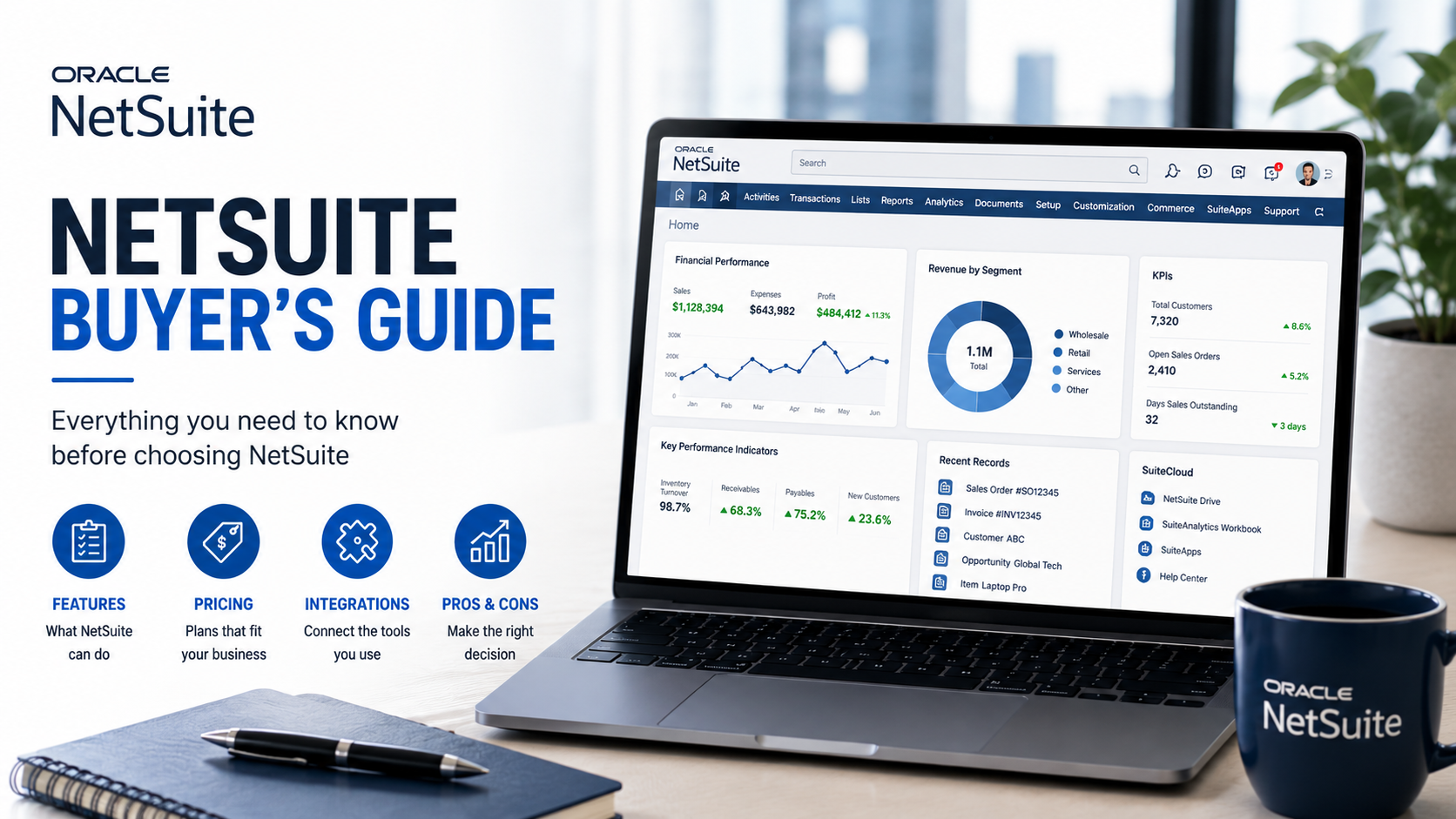
NetSuite is the most-evaluated mid-market ERP in the world and the most-quoted on Reddit, Capterra, and finance Slack groups. It is also the platform with the largest gap between the sales narrative and the post-go-live reality. This NetSuite buyer's guide is the honest version: what NetSuite genuinely does well, where the pricing traps live, which customisation patterns become unmaintainable, and the partner-due-diligence questions that determine whether your implementation finishes on plan.
If you are still in the early shortlist phase, also read NetSuite vs Odoo and NetSuite vs Dynamics 365 for the head-to-head decision patterns. For a cost-only view, our deep dive on how much an ERP really costs maps every line item that lands in a NetSuite proposal.
What Is NetSuite? (And Who's Behind It)
NetSuite is a cloud-native ERP launched in 1998 (originally NetLedger) and acquired by Oracle in 2016 for USD 9.3 billion. Oracle has kept NetSuite as a separate product line and brand, deliberately positioned as the cloud ERP for mid-market and upper-mid-market customers — the gap between QuickBooks Online or Xero at the small-business end and Oracle Fusion Cloud ERP at the enterprise end.
The product covers financials, order management, inventory, procurement, projects, manufacturing (light to moderate), CRM (SuiteCRM), ecommerce (SuiteCommerce), and revenue recognition (Advanced Revenue Management). OneWorld is the multi-entity / multi-currency / multi-country edition that most international buyers actually need. SuiteSuccess is Oracle's pre-configured industry edition (SaaS, Wholesale Distribution, Manufacturing, Non-Profit, Software, etc.), and SuiteCloud is the customisation platform — SuiteScript (JavaScript), SuiteFlow (workflows), and SuiteBuilder (configuration).
NetSuite is sold through three channels: Oracle-direct, Solution Providers (resellers who sell licences and implement), and Alliance Partners (implementation only). Globally available with localisations across the US, UK, EU (VAT, e-invoicing), Australia, New Zealand, India (GST), Brazil, Japan, and a growing list of GCC countries — though tax depth varies by region, which matters for the ecosystem section below.
NetSuite Pricing in 2026
NetSuite has no published list pricing. Every quote is negotiated, every renewal is leverage-sensitive, and the same configuration can be quoted very differently by different reps in the same month. The ranges below reflect 2026 mid-market deal patterns.
| Cost component | Typical range (USD) | Notes |
|---|---|---|
| Base platform (annual subscription) | $24K–60K/year starting | Includes a core set of users and base modules |
| Named user licence | $99–195/user/month | Full users; varies by module bundle and region |
| Limited / employee self-service users | $10–25/user/month | Far cheaper but very capability-limited |
| OneWorld add-on | $30K–80K/year | Required for multi-entity / multi-country |
| Advanced Revenue Management (ARM) | $20K–60K/year | Required for ASC 606 / IFRS 15 complexity |
| SuiteCommerce | $30K–120K/year | Often replaced by Shopify connector in practice |
| Implementation services | 1.5–3x annual subscription | Partner-delivered; complex programmes hit 3–5x |
| Customisation (SuiteScript / SuiteFlow) | $150–250/hour | Senior developers $200+ |
| Year-1 total (50 users, OneWorld, mid-complexity) | $180K–350K | Excludes large customisation or SuiteCommerce |
A few realities the sales motion downplays. Implementation routinely costs 3–4x the original quote when scope creeps. Renewal leverage evaporates once you are live — your data is in NetSuite's proprietary structures and migration out is genuinely painful. Transaction line tiers (covered below) trigger forced tier upgrades you did not budget for. Module add-ons can only be removed at renewal anniversaries.
Implementation Traps to Know Before You Sign
These traps are well-documented in customer communities. They are not exotic. If your partner has not warned you about each of them in writing, ask why.
| Trap | Severity | Why it bites |
|---|---|---|
| Transaction line tier lock | High | Exceeding 100K lines/month triggers a forced tier upgrade with immediate price jump |
| Opaque pricing and renewal lock-in | High | No list prices; renewals routinely raise 7–15% with limited leverage |
| Named user licensing | High | Every person needs a paid named licence — no shared read-only access |
| Module add-on creep | High | Modules can only be removed at renewal; add cautiously |
| SuiteScript layering and technical debt | High | Multiple custom scripts conflicting and degrading performance |
| Bi-annual upgrades break custom code | High | Twice-yearly releases routinely break poorly governed SuiteScript |
| Implementation cost reality (3–5x quote) | High | Most implementations exceed budget; budget at 5x to be safe |
| OneWorld multi-entity cost uplift | High | Multi-subsidiary / multi-currency requires OneWorld at significant extra cost |
| Data migration out (exit cost) | High | Migrating away is extremely painful due to proprietary data structures |
| "Yes to everything" partner risk | High | Partners who never push back build technical debt |
| SOAP API deprecation | Medium | No new SOAP endpoints from 2026.1; full removal scheduled for 2028.2 |
| Storage overage fees | Medium | File storage limits trigger fees outside the base subscription |
| ACS support value | Medium | Advanced Customer Support frequently flagged as poor value for cost |
| Over-customisation ("form hell", "role hell") | Medium | Unchecked admin customisation creates unmaintainable form and role sprawl |
The transaction line tier is the trap most buyers miss
NetSuite's pricing scales by transaction line volume per month. When you cross the 100K-line threshold, you are forced into a higher tier with an immediate price increase. Growing businesses regularly hit this without any operational change — just more invoices, more inventory transactions, more journal lines. Model your transaction line trajectory for the next 36 months before signing, and negotiate tier thresholds upfront. Without this, the platform becomes more expensive every year regardless of negotiation strength at renewal.
Renewal leverage is the second trap most buyers miss
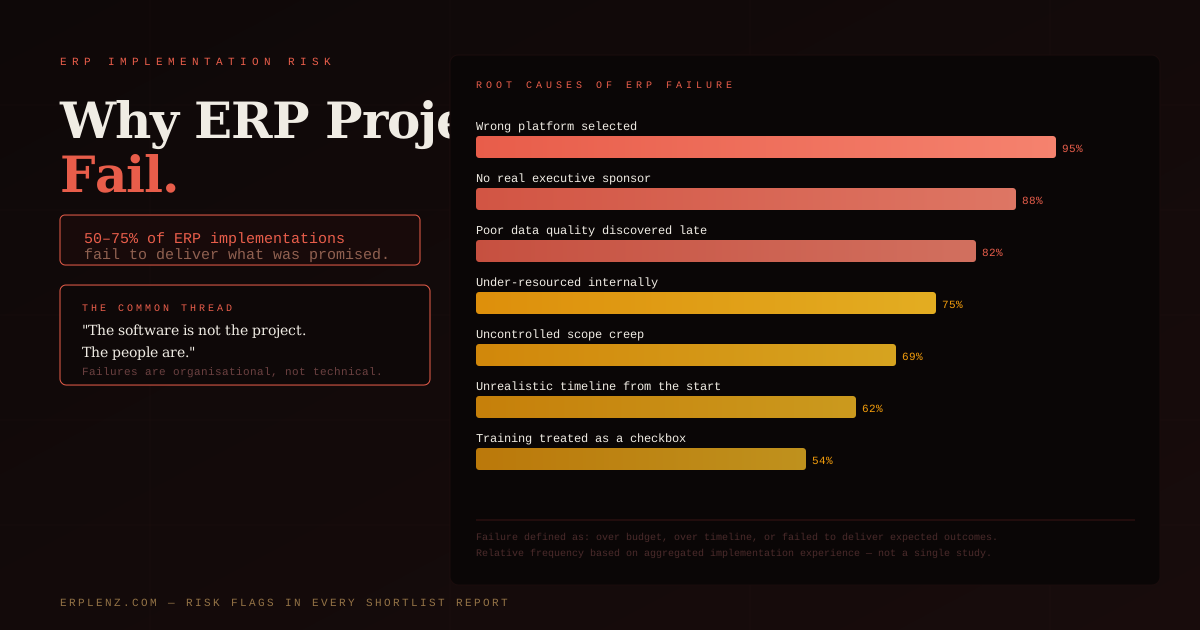
The day you go live on NetSuite, your negotiating leverage drops by an order of magnitude. Your finance team will not switch ERPs for a 12% renewal increase. The vendor knows this. Lock in renewal caps (ideally CPI-linked, capped at 3–5%) at the initial contract, not at renewal. Lock in multi-year terms. Negotiate exit assistance language. Our broader piece on why ERP implementations fail covers the commercial governance patterns that protect you long after the SOW is signed.
SuiteScript is powerful and dangerous
NetSuite's customisation power is genuinely impressive — SuiteScript can do almost anything. The problem is that it can also do almost anything, and partners under SOW pressure routinely script around configuration gaps that should have been redesigned. The result is "script layering": multiple custom scripts on the same record interacting in unpredictable ways, breaking after a Release Preview update. Strict customisation governance from day one matters more on NetSuite than on most platforms. See our perspective on how much ERP customisation is actually advisable.
Partner Questions That Matter
A NetSuite implementation is only as good as the partner. Use these questions to filter.
- Are you a Solution Provider (sells licences and implements) or an Alliance Partner (implementation only)? What is your incentive structure on this deal?
- Show me your proposed Statement of Work — specifically what is in scope, what is out of scope, and what triggers a change order.
- Who will be the lead consultant on our project? Can we meet them before signing? What is their personal certification level and how many NetSuite implementations have they personally led?
- How many clients in our industry, at our revenue size and transaction volume, have you implemented on NetSuite? Provide three references we can call.
- What is your policy on customisation — how do you decide between SuiteFlow, SuiteScript, and native configuration? Walk us through a recent example.
- How do you handle the bi-annual NetSuite upgrade cycle? Show us your regression testing process and Release Preview workflow.
- What is your pricing model — fixed fee or time and materials? If T&M, what is the change-order process and rate card?
- What post-go-live support do you offer? What are the SLAs for critical system issues, and what is the hourly rate outside the SOW?
- How do you protect us against renewal increases? Will you advise on commercial negotiation at renewal even though that potentially reduces your future revenue from licence resale?
Demo Requests to Insist On
Generic NetSuite demos are well-rehearsed. Insist on these scenarios live, with sample data shaped like yours.
- Bank reconciliation at scale. 500+ unmatched transactions. Show the automatic matching engine and the failure rate. NetSuite's native bank rec is genuinely weak — this is where ecosystem tools like ZoneReconcile typically get added.
- OneWorld consolidation. Show intercompany eliminations across three subsidiaries with multi-currency revaluation.
- SuiteScript deployment. A real customisation moved from sandbox to production. Show the version control and change-management process.
- Bi-annual upgrade in Release Preview. Show how customisations are tested before the production release lands.
- Transaction line tier monitoring. How do you monitor monthly line counts against your service tier limit? Show the dashboard.
- Advanced Revenue Management (ARM). Recognise revenue across a multi-element subscription arrangement with mid-term modifications.
- Sandbox refresh and data masking. Show how a development sandbox is refreshed from production and how PII is handled.
Our piece on ERP vendor demo red flags covers the wider pattern of what to push for in any demo cycle.
Recommended Ecosystem Tools
Almost no NetSuite deployment runs on the base product alone. The third-party ecosystem is mature and largely necessary — most experienced NetSuite admins layer in several of the tools below.
| Tool | What it does | Gap it fills |
|---|---|---|
| Zone & Co — ZoneReconcile | Automated bank and intercompany reconciliation with rule-based matching | NetSuite's native bank reconciliation is weak — manual matching, limited rules |
| Zone & Co — ZoneBilling | Subscription billing, usage billing, revenue schedules | NetSuite native billing is limited for complex SaaS or usage-based pricing |
| Ramp / Expensify / Concur | Corporate card and expense management with NetSuite sync | NetSuite's native expense reports are clunky; these add mobile capture and approvals |
| BlackLine | Account reconciliation and close management | NetSuite month-end close is manual; BlackLine adds tasks, templates, audit trails |
| Celigo / Boomi | iPaaS for connecting NetSuite to third-party systems | SuiteFlow is limited for complex bi-directional integrations |
| Avalara / TaxJar | Automated sales tax calculation and filing | NetSuite's native tax engine cannot handle US multi-state complexity |
| Strongpoint | Change management, documentation, SOX compliance for SuiteScript | NetSuite has no native script governance; critical for audited businesses |
| FloQast | Close management and reconciliation | Ties NetSuite transactions to Excel workpapers for month-end |
| Paychex / ADP / Employment Hero | Payroll integration | SuitePeople is US-only and limited; dedicated payroll serves other regions |
| Shopify / BigCommerce connector | Ecommerce-to-NetSuite sync | SuiteCommerce is expensive; connectors sync third-party stores cleanly |
Who NetSuite Is For (and Who It Isn't)
| Dimension | Strong fit | Weak fit |
|---|---|---|
| Size | 75–500 employees, USD 10M–100M revenue | <50 employees (over-engineered, too costly); >500 employees (consider Oracle Fusion) |
| Industry | SaaS, services, wholesale distribution, light manufacturing, ecommerce-driven | Complex process manufacturing, heavy MES integration, project-engineering-led firms |
| Complexity | Multi-entity, multi-currency, ASC 606 / IFRS 15 revenue recognition, ecommerce-finance unification | Single-entity, single-country, low-complexity finance |
| Geography | Global — strong North America, UK, EU, ANZ, India, parts of GCC | Regions with limited NetSuite localisation depth (some LATAM, parts of MENA) |
| IT posture | Cloud-first, comfortable with continuous updates and bi-annual releases | Heavily regulated industries needing data residency or on-premise control |
These are general categories. Whether NetSuite is the right answer for your specific operating model, growth trajectory, and integration map depends on dozens of variables only a structured evaluation surfaces.
NetSuite vs Alternatives
The two most common head-to-heads at this scale are NetSuite versus Microsoft Dynamics 365 Business Central and NetSuite versus Odoo Enterprise. Our deep-dive comparisons cover both: NetSuite vs Odoo maps the open-source-versus-Oracle trade-off, and NetSuite vs Dynamics 365 covers the cloud-finance heavyweight comparison. Sage Intacct competes strongly for services-only businesses without inventory or manufacturing. Acumatica competes on consumption pricing and is stronger for distribution and construction in the US/UK/AU markets. SAP Business One competes in the same band internationally, particularly outside the US. For capabilities, fit, and where NetSuite sits among these, see our NetSuite platform profile.
Frequently Asked Questions
How much does NetSuite cost?
Realistic Year-1 totals for a 50-user mid-complexity NetSuite deployment with OneWorld run USD 180K–350K, including base platform, named user licences, OneWorld multi-entity, ARM (if needed), implementation services at roughly 1.5–3x the annual subscription, and one round of data migration. Subscription cost alone is typically USD 60K–150K/year for this configuration. NetSuite does not publish list prices — every quote is negotiated. Renewal increases of 7–15% are common unless caps are negotiated at signing.
Is NetSuite good for manufacturing?
NetSuite handles light to moderate discrete manufacturing well: BOMs, work orders, routings, basic shop floor reporting, serial and lot tracking. It is competitive with Microsoft Dynamics 365 Business Central in this band and stronger than Sage Intacct (which has no manufacturing). It is not a fit for complex process manufacturing (chemicals, food formulation with batch yield variance), high-volume repetitive manufacturing, or shops needing deep MES and shop-floor integration. For those, SAP S/4HANA, Syspro, or a dedicated process ERP is a better answer.
Who owns NetSuite?
Oracle Corporation owns NetSuite. Oracle acquired NetSuite Inc. in November 2016 for USD 9.3 billion. NetSuite continues to operate as a distinct product line within Oracle, separately branded and engineered from Oracle Fusion Cloud ERP. Larry Ellison was an early investor in NetSuite before the acquisition, which is part of the company's commercial origin story.
Can I implement NetSuite myself?
Practically, no. Oracle effectively requires implementation to be done by NetSuite Professional Services or a certified Solution Provider / Alliance Partner. Even shops with strong internal Salesforce admin skills find that NetSuite's data model, customisation platform (SuiteScript / SuiteFlow / SuiteBuilder), and bi-annual release cadence demand specialist expertise. Some smaller deployments use a partner for the build and bring administration in-house afterwards, which works when the customisation footprint is disciplined.
How long does a NetSuite implementation take?
Realistic timelines for a mid-market NetSuite deployment run 4–9 months for single-entity, single-country implementations, and 9–18 months for OneWorld multi-entity rollouts across multiple geographies. SuiteSuccess pre-configured editions can compress timelines by 30–40% for textbook industry fits. Our detailed view on how long ERP implementation takes covers the variables that compress or expand these ranges.
What are the main NetSuite alternatives?
The most common alternatives are Microsoft Dynamics 365 Business Central (similar mid-market footprint, Microsoft ecosystem, ISV-heavy), Sage Intacct (finance-only, no inventory or manufacturing, strong for services and non-profits), Acumatica (consumption pricing, US/UK/AU concentration), SAP Business One (partner-only, stronger international localisation), Odoo Enterprise (cheaper, more flexible, less mature for complex compliance), and Oracle Fusion Cloud ERP (upper-mid-market and above). Read our piece on how to choose an ERP in 2026 for the wider selection framework.
What is NetSuite OneWorld and do I need it?
OneWorld is NetSuite's multi-entity, multi-currency, multi-country edition. It enables consolidated reporting, intercompany transactions and eliminations, currency revaluation, and country-specific tax and compliance configurations on a per-subsidiary basis. If your business has more than one legal entity, operates in more than one country, or expects to within three years, you need OneWorld. The cost uplift is significant (typically USD 30K–80K/year on top of base subscription) but the alternative — running separate NetSuite accounts per entity — is operationally worse and ultimately more expensive.
Why are NetSuite renewals so contentious?
Once you are live on NetSuite, your switching cost is high and the vendor knows it. Renewal increases of 7–15% are common; some buyers report 20%+ at renewal. The defence is purely contractual: negotiate renewal caps (ideally CPI-linked, capped at 3–5%) at the initial contract, lock in multi-year terms with extension options on the same caps, and explicitly negotiate exit assistance language. Start renewal negotiations 90 days before your renewal date, not 30. The leverage you have at original purchase you will never have again.
How ERPLenz Can Help
This guide gives you the NetSuite landscape: the pricing structure, the trap matrix, the partner-due-diligence questions, the demos to insist on, and the ecosystem you will inevitably need to layer on top. What it does not tell you is whether NetSuite is the right answer for your specific business — your industry, growth profile, transaction volume trajectory, integration map, and geographic complexity.
ERPLenz answers that question. Our 116-point diagnostic produces a ranked shortlist of three platforms calibrated to your business, with risk flags per platform, a five-year TCO modelled on your specific scale and geography, and (in the Deep Report) partner recommendations in your region. We do not sell NetSuite licences — or any other vendor's. Our only loyalty is to the buyer.
Get your free ERP budget reality check →
The vendors who paid for advertising do not write articles like this one. ERPLenz exists to give mid-market ERP buyers the calibrated, vendor-agnostic picture the sales motion will not.