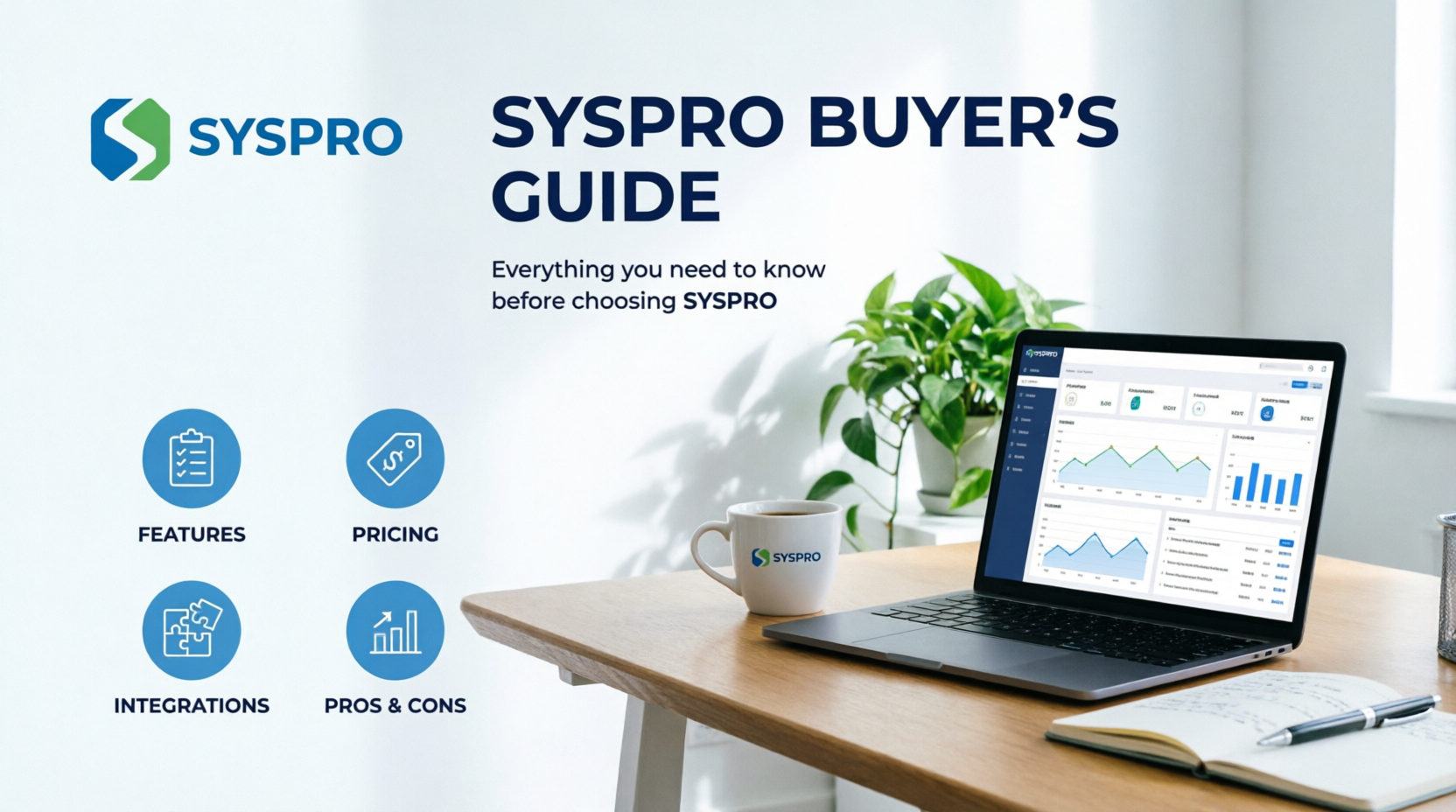
Buying Syspro: Pricing, Manufacturing Fit, and the Talent Pool Reality for 2026
Quick answer: Syspro is a manufacturing-focused mid-market ERP with deep functionality for discrete and food-and-beverage manufacturers. Buy Syspro if you make physical products, value functional depth over UI gloss, and have a stable supplier-partner relationship. Avoid Syspro if you operate outside its manufacturing/distribution niche, need a large pool of interchangeable consultants, or want a cloud-first SaaS experience. Realistic Year-1 cost for a 75–250 employee manufacturer lands in the USD $130K–$380K range. Best implementation pattern: phased, manufacturing-module-led, with a specialist partner you've vetted personally.
Syspro is a different kind of ERP from the loud cloud-native names dominating the 2026 market. It has been around since 1978, is privately held, and has built its reputation on manufacturing depth rather than marketing budget. For mid-market discrete manufacturers, food and beverage producers, and industrial distributors, Syspro consistently outperforms NetSuite, Dynamics 365 Business Central, and Acumatica on functional fit — and consistently underperforms them on consultant availability, ecosystem breadth, and UI modernisation.
This Syspro buyer's guide covers 2026 pricing, the implementation risks specific to a niche manufacturing ERP, the partner questions that matter when the talent pool is thin, and how to think about Syspro against the broader mid-market cloud ERP field.
What Is Syspro? (And Who's Behind It)
Syspro is a privately-held ERP vendor founded in 1978 and headquartered in Johannesburg, South Africa, with major regional operations in the US (Costa Mesa, California), the UK, Canada, Australia, and across APAC and Africa. Unlike most mid-market ERP vendors, it has remained independent — no PE rollup, no Oracle or Sage acquisition — and consistently reinvests in product depth rather than horizontal expansion.
The product is purpose-built for discrete manufacturing, food and beverage manufacturing, and industrial distribution. Core modules cover financials, multi-level BOMs, MRP, shop floor data collection, lot and serial tracking, advanced inventory costing (FIFO, LIFO, average, standard, actual), warehouse management, sales orders, purchase orders, and quality management. The depth in production scheduling, factory documentation, and inventory costing routinely matches or exceeds NetSuite Manufacturing and SAP Business One Manufacturing.
Deployment options include on-premise (still the most common Syspro install base), private cloud hosted by the customer or partner, and Syspro Cloud — the vendor's SaaS offering, which is newer and less mature than the on-premise product. Global reach is strongest in Africa, Australasia, North America, and the UK, with growing presence in Southeast Asia. Localisation in continental Europe, LATAM, GCC, and India is thinner than NetSuite or SAP.
Syspro's competitive position is not "best mid-market ERP for everyone" — it is "best mid-market ERP for product manufacturers in our niches, if you can staff a partner relationship". That framing matters for the rest of this guide.
Syspro Pricing in 2026
Syspro pricing is per-named-user, with separate licences for full users and lighter functional roles (warehouse scanner, shop floor terminal, finance-only, etc.). It is sold through partners and is not published. For the wider context on ERP cost components and what drives mid-market budgets, see how much does ERP cost.
Indicative 2026 ranges (USD, negotiated through partners):
| Component | Range | Notes |
|---|---|---|
| Per full user, perpetual licence (on-premise) | $3,000–$5,500 one-time | Plus ~18–22% annual maintenance on perpetual |
| Per full user, subscription (Syspro Cloud) | $150–$280 / month | Includes hosting and updates |
| Per lighter user (scanner, shop floor, view-only) | $30–$120 / month | Or $700–$1,800 perpetual |
| Annual maintenance on perpetual licences | 18–22% of licence cost | Required for support and updates |
| Implementation (single-site manufacturer, 50–100 users) | $90,000–$220,000 | Typically 1.5–3x annual subscription |
| Implementation (multi-site, complex manufacturing, lot/serial, quality) | $220,000–$500,000+ | Approaches NetSuite Manufacturing territory |
| Typical Year-1 total (mid-market manufacturer) | $130,000–$380,000 | Excludes ISV tools — Power BI, EDI, WMS extensions |
Two cost dynamics distinguish Syspro from cloud peers. First, on-premise infrastructure costs are real and ongoing — SQL Server licences, server hardware or hosting, DBA time, backup, disaster recovery. Many Syspro customers underestimate this by USD $30K–$80K/year. Second, Syspro's reporting and dashboarding ecosystem typically requires SQL Server Reporting Services and/or Power BI on top of the core product, which means budget for a BI workstream separate from the ERP implementation.
If you're weighing whether to deploy Syspro on-prem or in Syspro Cloud, the wider trade-offs in our cloud vs on-premise ERP guide apply directly here.
Implementation Traps to Know Before You Sign
Syspro implementations fail less often than NetSuite or Dynamics 365 F&O implementations because the buyer profile is usually pre-qualified — you don't accidentally end up on Syspro the way you can accidentally end up on NetSuite. But the failure modes that do exist have a distinctive flavour.
| Trap | Severity | What Happens |
|---|---|---|
| Talent pool scarcity | High | Very small pool of Syspro-certified consultants globally. Losing a consultant mid-project is genuinely painful. |
| Vertical concentration risk | High | Strong in F&B, discrete manufacturing, distribution. Poor fit for services, SaaS, non-profit, professional services. |
| Cloud product maturity | High | Syspro Cloud is newer than the on-premise product. Some features, integrations, and ISV add-ons trail the on-prem version. |
| Smaller ecosystem | Medium | Limited global partner network and third-party app marketplace compared to NetSuite, Dynamics, or SAP. |
| UI modernisation lag | Medium | Interface is functional but lags more modern cloud-native ERPs. User adoption can be slower with younger workforces. |
| Multi-country gaps | Medium | Localisation is solid in core markets (US, UK, AU, ZA) but thin in EU, India, GCC, LATAM. Multi-country deployments need workarounds. |
| Reporting tool dependency | Medium | Meaningful reporting requires SRS or Power BI investment alongside the core ERP. |
| On-premise upgrade inertia | Medium | On-prem Syspro customers often stay on old versions for years; upgrading heavily-customised installs is painful. |
| Partner quality variance | Medium | Small partner pool means there's a long tail of weak partners; one bad partner can do real damage. |
| EDI and ecommerce gaps | Watch | No native EDI; ecommerce integration requires Datalinker, B2B partners, or middleware. |
The talent pool one is structural. Where NetSuite has thousands of consultants and you can swap a bad one out in weeks, Syspro has hundreds globally and the senior bench is small. This shapes everything about how you should select a partner — covered next. For more on the broader pattern of niche-vs-major ERP risks, see our major vendor vs niche ERP comparison.
Partner Questions That Matter
For a niche ERP like Syspro, partner selection isn't important — it's almost everything. The following questions separate genuine specialists from generalists:
- What is the size of your dedicated Syspro practice — how many active consultants, and what is their average years-with-Syspro tenure? A practice with 4 consultants of 8+ years experience is usually safer than one with 12 consultants averaging 2 years.
- Given the small Syspro consultant pool, who specifically are the named people on our project? What are their certifications, what was their last project, and can we speak to those clients? Generic references don't cut it.
- Are you recommending on-premise, hosted, or Syspro Cloud — and why for our specific case? What is the 5-year total infrastructure cost in your recommendation? Cloud-versus-on-prem is a 5–10 year decision; demand the math.
- What is your patch and upgrade methodology for on-premise installations? Show us how customisations from your last project survived the most recent major upgrade. This is where on-premise Syspro customers most often get stuck.
- What third-party tools do you typically deploy alongside Syspro for our industry — reporting, BI, EDI, CRM, ecommerce? What does that combined stack cost? Syspro is rarely deployed alone in a serious operation.
- What is your post-go-live support model and SLA? Given the small consultant pool, what happens if our lead consultant leaves your firm? Continuity risk is the under-discussed dimension of niche-ERP partner selection.
- Do you have references from manufacturers in our specific sub-vertical — automotive parts, dairy, packaged food, building products, electronics, fabricated metals? Manufacturing is not one industry; sub-vertical fit matters.
For more on the partner-vs-vendor channel across mid-market ERP, see implementation partner vs vendor-direct.
Demo Requests to Insist On
A Syspro demo is where the product's manufacturing depth shows. Insist on:
- The manufacturing module live — shop floor scheduling, job costing, and variance analysis against a real-feeling production scenario. Don't accept a finance-led demo. The product's value lives on the factory floor.
- Inventory costing methods — FIFO, LIFO, average, standard, actual. Show the configuration and demonstrate switching costing methods for one product class. This depth is one of Syspro's signature strengths.
- Lot and serial tracking with full traceability from raw material to finished good to customer shipment. Critical for F&B, automotive, regulated manufacturing.
- MRP run on a representative product mix with multi-level BOMs. Time it. Look at exception handling.
- The bank reconciliation process at representative transaction volume. This is often where niche manufacturing ERPs underperform; insist on a real demo.
- Syspro Reporting Services or Power BI live — a custom management report built from scratch. Reporting capability is a known gap point; force the issue in the demo.
- The Syspro Cloud product specifically (if that's your deployment direction). Don't accept an on-premise demo as proof of cloud capability; they have feature gaps.
Recommended Ecosystem Tools
Syspro is almost always deployed with a small surrounding stack to fill native gaps:
| Tool | What It Does | Gap It Fills |
|---|---|---|
| Syspro Reporting Services (SRS) | Custom reports on SQL Server Reporting Services | Native reports are basic; SRS adds formatted, scheduled report delivery |
| Power BI | Interactive BI dashboards | Native dashboards are dated; Power BI connects to the Syspro SQL backend for modern BI |
| Sage CRM or Salesforce | CRM integration | Syspro has no native CRM; CRM bolt-on is standard |
| Datalinker | EDI and B2B document exchange | No native EDI; required for retailer-compliance trading |
| Stambia or Boomi | iPaaS / middleware | Syspro APIs are functional but older; middleware adds reliability for complex integrations |
| WMS Express or DataNow | Advanced warehouse management | Native WMS is functional; specialist WMS adds directed putaway and pick optimisation |
| Phocas | Sales and inventory analytics | Strong choice for distribution and manufacturing analytics on Syspro data |
| Tasklet Factory | Mobile warehouse and shop floor scanning | Adds modern mobile scanning workflows |
Who Syspro Is For (and Who It Isn't)
| Profile | Fit | Why |
|---|---|---|
| Discrete manufacturers (automotive parts, electronics, fabricated metals), 75–500 employees | Strong | Deep MRP, costing, scheduling, BOM management — Syspro's core strength |
| Food and beverage manufacturers | Strong | Lot tracking, traceability, batch and recipe management are mature |
| Industrial distributors with manufacturing-aware operations | Strong | Inventory costing depth is genuinely best-in-class for the price point |
| Process manufacturers (chemicals, paint, cosmetics) | Good | Capable for most scenarios; complex process needs careful evaluation |
| Engineer-to-order and project-based manufacturing | Mixed | Capable but other vertical ERPs (Aptean, Infor CloudSuite Industrial) may go deeper |
| Services-led, SaaS, professional services | Poor | Not Syspro's niche; use NetSuite, Sage Intacct, or Acumatica |
| Multi-region global businesses (8+ countries) | Weak | Localisation outside core English-speaking markets is thinner |
| Buyers wanting a large interchangeable consultant pool | Weak | Talent pool is small by design; this is a feature for specialists, a risk for generalists |
| Pure retail or ecommerce-only businesses | Poor | No native POS, ecommerce integration via middleware |
| Non-profits, government, education | Poor | Wrong vertical entirely |
Syspro vs Alternatives
The most useful Syspro comparisons:
- Syspro vs NetSuite Manufacturing — Syspro typically wins on functional depth for traditional manufacturing; NetSuite wins on ecosystem, global reach, and cloud-native experience. For a US manufacturer with 5+ global subsidiaries, NetSuite is usually the safer bet. For a single-country manufacturer prioritising depth over breadth, Syspro often beats it on fit and cost.
- Syspro vs SAP Business One — both have strong manufacturing functionality. B1 has the SAP brand and larger global partner pool; Syspro has independent ownership, more advanced inventory costing, and (in many regions) better partner depth.
- Syspro vs Acumatica Manufacturing — Acumatica wins on UI modernisation, cloud-native experience, and consumption pricing. Syspro wins on functional depth in advanced costing and shop floor.
- Syspro vs vertical/niche manufacturing ERPs (Aptean, Infor CloudSuite Industrial, ProcessPro) — vertical players often go deeper in their specific sub-vertical but lose on commercial scale and product investment. See major vendor vs niche ERP for the broader trade-off framework.
For capabilities and fit, see the Syspro platform profile. Compare it head-to-head: Syspro vs ERPNext, Syspro vs SAP Business One, Syspro vs Dynamics 365 Business Central. Syspro is a strong fit for manufacturing businesses.
Frequently Asked Questions
How much does Syspro cost in 2026?
For mid-market manufacturers (75–500 employees), Year-1 totals typically run USD $130K–$380K. Per-user perpetual licences are USD $3,000–$5,500 plus 18–22% annual maintenance; Syspro Cloud subscription runs USD $150–$280 per full user per month, with cheaper licences for warehouse scanners and shop floor terminals. Implementation adds 1.5–3x annual subscription. On-premise deployments carry meaningful additional infrastructure costs — SQL Server, hosting, DBA time — that buyers often under-budget by USD $30K–$80K per year.
Is Syspro a cloud ERP?
Syspro is available in the cloud (Syspro Cloud) but is historically on-premise first. The on-premise product is more mature and carries the bulk of the install base globally. Syspro Cloud is a genuine SaaS offering and continues to mature, but some features, integrations, and ISV add-ons trail the on-premise version. If a cloud-native SaaS experience is non-negotiable, evaluate Syspro Cloud specifically (don't accept on-prem demos as proof) and compare against fully cloud-native peers like Acumatica, NetSuite, or Dynamics 365 Business Central.
Who owns Syspro?
Syspro is privately held and independently owned, founded in 1978 and headquartered in Johannesburg, South Africa. Unlike most mid-market ERP competitors, it has not been rolled up into a PE portfolio or acquired by a larger software conglomerate. This has practical implications: product investment focuses on vertical depth rather than horizontal expansion, the company is conservative financially, and there is no looming "migration to the parent platform" pressure that affects products like JD Edwards (Oracle) or Sage Business Cloud customers.
Is Syspro good for manufacturing?
Yes — manufacturing is Syspro's core strength. The product offers deep functionality across discrete and food-and-beverage manufacturing, including multi-level BOMs, MRP, shop floor data collection, advanced inventory costing (FIFO, LIFO, average, standard, actual), lot and serial tracking, quality management, and production scheduling. For mid-market manufacturers in its core sub-verticals (automotive parts, electronics, fabricated metals, dairy, packaged food, building products), Syspro frequently outperforms NetSuite Manufacturing, SAP Business One, and Acumatica Manufacturing on functional fit.
Can I implement Syspro myself?
Not realistically. Syspro is sold and implemented exclusively through certified partners, and the platform's depth in manufacturing means internal IT teams cannot stand up a serious production deployment alone. Single-site manufacturer implementations typically take 6–12 months with a partner; multi-site or complex manufacturing programmes run 9–18 months. The smaller global Syspro consultant pool means partner selection is more consequential than for major-vendor ERPs — losing a consultant mid-project has fewer alternatives. Vet the named delivery team, not just the firm.
How long does a Syspro implementation take?
Single-site manufacturer implementations typically take 6–12 months from kick-off to go-live. Multi-site deployments with complex BOMs, lot tracking, and integrated WMS run 9–18 months. Adding EDI, advanced costing scenarios, or significant CRM integration extends timelines further. The biggest schedule risk is over-customisation — Syspro is flexible enough to be tailored extensively, and partners who over-customise create upgrade pain that compounds for years. Plan for 4–8 weeks of post-go-live hypercare. Realistic expectations matter; see how long does ERP implementation take for the broader pattern.
What are the main alternatives to Syspro?
For mid-market manufacturers Syspro doesn't suit: NetSuite Manufacturing, SAP Business One, Microsoft Dynamics 365 Business Central with manufacturing extensions, Acumatica Manufacturing, Epicor Kinetic, Infor CloudSuite Industrial, Aptean (industry-specific), or IFS Cloud. For services-led buyers or non-manufacturers who landed on Syspro by mistake: Sage Intacct, Acumatica General Business, NetSuite, or Dynamics 365 Business Central. The right alternative depends on your sub-vertical, geography, deployment preference, and the relative weight of manufacturing depth versus ecosystem breadth.
Does Syspro work globally?
Yes, with caveats. Syspro has strong product coverage and partner depth in South Africa, Australia, New Zealand, the UK, the US, Canada, and parts of Southeast Asia. Localisation in continental Europe, India, GCC, LATAM, and Japan is thinner and often partner-dependent. Multi-currency and intercompany functionality is solid in core markets. For genuinely global manufacturers operating across 8+ countries with varied tax regimes (US sales tax, UK MTD, EU VAT, India GST, ZATCA, Brazilian SPED), validate localisation depth carefully in the demo and consider whether NetSuite or SAP would be a safer cross-border bet.
How ERPLenz Can Help
You now have the shape of the Syspro decision: deep manufacturing functionality, independent ownership, smaller consultant pool, and a specific sub-vertical sweet spot. What this guide cannot do is tell you whether your manufacturing operation falls inside Syspro's sweet spot, whether the partner ecosystem in your region is strong enough for your project, or whether the 5-year TCO including on-premise infrastructure makes sense versus a fully cloud-native alternative.
That is the calibrated work the ERPLenz report does. We run your business profile through a 116-point diagnostic and produce a ranked shortlist of three platforms with vendor-by-vendor risk flags, a 5-year TCO that accounts for infrastructure, ISVs, and likely growth, and (in the Deep Report) partner recommendations in your region — specifically including whether a Syspro specialist with the right manufacturing sub-vertical experience is available where you operate.
Syspro rewards manufacturers who care more about depth than gloss — and quietly fails the buyers who picked it because a generalist consultant happened to know it. Knowing which buyer you are is the entire decision.