Buying Zoho Books and Inventory: Pricing, Walled-Garden Risk, and the Real Implementation Traps
Quick answer: Buy Zoho Books (and Zoho Inventory) if you are a price-sensitive small business — especially in India, the GCC, LATAM, or anywhere outside the Anglosphere — that is comfortable adopting the wider Zoho stack. Avoid Zoho Books if you need multi-entity consolidation, serious manufacturing depth, or independence from a single vendor ecosystem. Realistic Year-1 cost: USD $700–$6,000 for Books-only; USD $5,000–$30,000+ for Zoho One across a small team. Best implementation pattern: native Zoho stack only, no external custom development.
Zoho Books is the cheapest serious small-business accounting product on the market — by a wide margin in some regions. Zoho Inventory adds genuinely capable inventory management at a fraction of the cost of Cin7 or DEAR. And Zoho One bundles 40+ apps together at a per-employee price that looks like a rounding error compared to NetSuite. The trap is not the product — it is the ecosystem decision the product quietly forces you into.
This guide is for buyers evaluating Zoho Books and Zoho Inventory as the financial and operational backbone of a small business. It walks the real cost stack, the implementation traps, the partner questions to ask, and the conditions under which Zoho's walled-garden model becomes a liability. The framing is global — Zoho is headquartered in India and Texas, has its deepest market in India, strong presence in the GCC, AU, LATAM, and Southeast Asia, and a growing footprint in the UK, EU, and US.
What Is Zoho Books? (And Who's Behind It)
Zoho Corporation is a privately held software company headquartered in Chennai (India) and Pleasanton, California — one of the largest privately owned global SaaS vendors. Zoho is famously bootstrapped (no VC funding), profitable, and product-led, which gives the company unusual pricing flexibility and a long product release horizon.
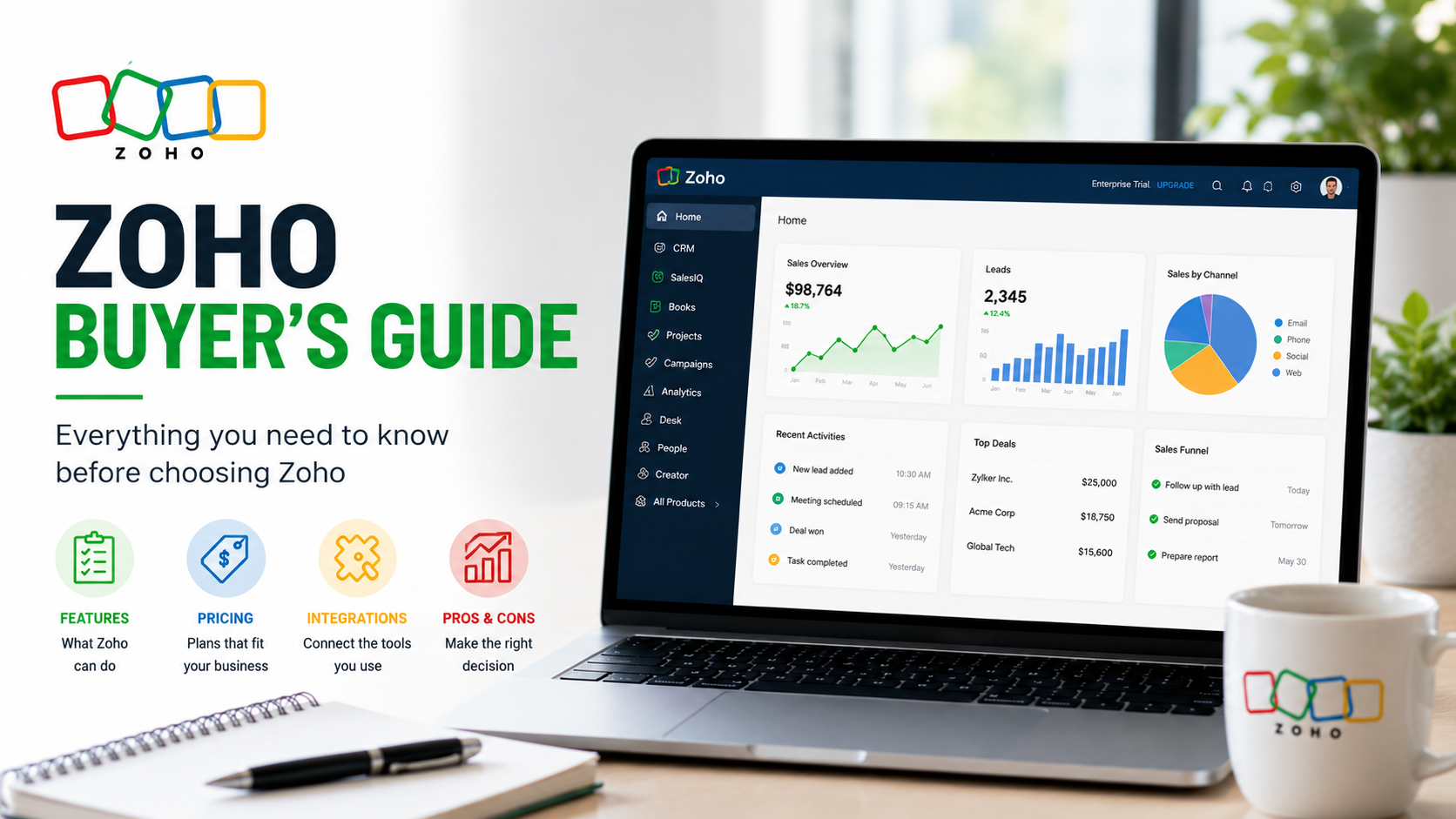
Zoho Books is the company's cloud accounting product. Zoho Inventory adds multi-warehouse inventory management, order fulfilment, and B2B / B2C order workflows. Both can be bought standalone, but Zoho's commercial model is built around pulling you into Zoho One — a bundle of 40+ applications (CRM, Books, Inventory, Projects, Desk, Analytics, Mail, Sign, Creator, and so on) at a single per-employee price.
Target segment is micro and small business — under 50 staff, under USD $10M revenue — though Zoho Books punches above its weight, scaling cleanly to 50–75 staff in service businesses. Deployment is SaaS only. Country coverage and localisation are unusually wide — Zoho supports India GST, UK MTD, EU VAT, AU GST, GCC VAT (including ZATCA in KSA and UAE VAT), Canada, the US, Mexico, South Africa, and most of Southeast Asia natively.
For where this sits in the broader ERP tier framework, see the Micro and Small Business tier guide.
Zoho Books Pricing in 2026
Zoho publishes plan pricing globally and lists each market separately. The base prices are dramatically lower than Xero, QBO, or Sage — but the realistic spend depends on whether you stop at Books or commit to Zoho One.
| Cost layer | Range (USD per month) | Notes |
|---|---|---|
| Zoho Books Free | $0 | Up to $50K revenue (India free up to ₹25 lakh) |
| Zoho Books Standard | $15–$20 | 3 users; basic plan |
| Zoho Books Professional | $30–$40 | 5 users; multi-currency, projects |
| Zoho Books Premium | $50–$60 | 10 users; budgeting, custom domain |
| Zoho Books Elite | $130–$150 | 10 users; advanced inventory |
| Zoho Books Ultimate | $240–$275 | 15 users; advanced analytics |
| Zoho Inventory | $30–$300 | Standalone plans by order volume |
| Zoho One (full bundle) | $37–$45 per employee per month | All-employees licensing required |
| Zoho Analytics | $25–$455 | Standalone; advanced BI |
Realistic Year-1 spend for a 10-person business on Zoho Books Premium with Zoho Inventory and Zoho Sign is USD $700–$2,500 — a fraction of the Xero / QBO equivalent. Move that same business onto Zoho One and the cost jumps to USD $4,500–$5,500 per year, because Zoho One is licensed against every employee, not against active users. A 50-person business on Zoho One lands USD $22,000–$27,000 per year.
For multi-tier ERP cost benchmarks, see how much does ERP cost.
Implementation Traps to Know Before You Sign
Zoho Books is implemented in weeks, not months, and most setups never involve a traditional system integrator. But the platform has a specific trap pattern that catches scaling businesses.
The walled-garden / ecosystem lock-in is the defining risk. Zoho's commercial strategy is to be your single vendor for everything. Once Books, CRM, Inventory, Projects, Desk, and Analytics are wired together, swapping any one of them for a best-in-class third party is a multi-month integration project. The savings of the bundle become the cost of exit.
No native multi-entity consolidation. Each entity is its own Zoho Books organisation. Group reporting must be done in Zoho Analytics, exported, or rebuilt manually. The pattern is identical to Xero, QBO, and Sage Business Cloud — but Zoho's pricing makes it harder to spot, because adding a second entity feels cheap.
Module proliferation hides the real cost. Zoho Books, Zoho Inventory, Zoho Projects, Zoho CRM, Zoho Subscriptions, Zoho Expense — each one has its own pricing tiers, its own user limits, and its own integration touch-points. Buyers who start with just Books and "add what we need" end up paying more than Zoho One would have cost.
User limits by plan are real. The lower plans cap users hard. The Elite and Ultimate plans relax this but cost more per month than the equivalent Xero or QBO plan — closing the price gap that drew the buyer to Zoho in the first place.
Third-party integrations are far fewer than Xero or QBO. Zoho's strength is its internal ecosystem; the marketplace of external apps is materially thinner. If your business depends on a specific external SaaS — a niche WMS, a specific PSA, a regional payroll provider — confirm the integration exists before signing.
Customisation depth is uneven across the suite. Zoho Books has solid customisation for invoices, workflows, and reporting. The CRM allows Zoho Creator (low-code) extensions. But chart-of-accounts flexibility, custom modules, and advanced revenue recognition lag behind QBO or NetSuite.
Support quality is famously inconsistent. Zoho's product range is enormous and the support model varies by product, country, and severity. Premium support exists but is an additional cost most buyers do not factor in.
| Trap | Severity | What it costs you |
|---|---|---|
| Walled-garden / Zoho ecosystem lock-in | High | Exit cost of 6–12 months of replacement projects |
| No native multi-entity consolidation | High | Manual close cycle; audit exposure |
| Module proliferation across the suite | Medium | Surprise line-items as needs grow |
| User cap by plan | Medium | Forced plan upgrade as team grows |
| Sparse external app marketplace | Medium | Custom integration cost or feature gap |
| Customisation ceiling vs QBO / NetSuite | Watch | Workflow workarounds in growing businesses |
| Support quality variance | Watch | Slow resolution on niche issues |
Partner Questions That Matter
Zoho Books rarely involves a traditional implementation partner — most setups go through an accountant, a Zoho Advanced Partner, or are self-implemented. These questions still apply, especially if you are buying Zoho One rather than Books alone.
- Which Zoho apps are you actually recommending alongside Books and Inventory, and what is the full cost per user? Get the realistic stack in writing before signing.
- If we need a capability Zoho does not have natively, how do you handle it — custom development in Zoho Creator, third-party integration, or replacing with a non-Zoho tool? An honest partner has an opinion.
- How many Zoho Books and Inventory clients have you implemented at our size and transaction volume? Specifically — at this size in this industry, not "we have Zoho clients".
- What is your upgrade and maintenance process when Zoho releases major updates? Zoho's release cadence is fast; testing is the partner's responsibility.
- How do you handle data migration out of Zoho if we need to move to a full ERP in 3 years? Advisors with no answer here have not seen exit projects.
If the answer to "which apps" is "all of them, you'll see", you have a sales pitch, not an implementation plan.
Demo Requests to Insist On
Even at this tier, do not buy on a generic vendor demo. Insist on seeing:
- The full order-to-cash flow from sales order in Zoho CRM through to invoice and payment reconciliation in Zoho Books. This is the ecosystem story tested under one workflow.
- Multi-warehouse inventory movements and how they post to accounting in real time. Zoho Inventory's depth here is one of its strongest selling points — confirm it works for your patterns.
- A live Zoho Analytics dashboard built from scratch — pulling from CRM, Books, and Projects. Tests whether the "unified data" story is actually unified.
- What multi-company consolidation looks like. Expect manual workarounds — confirming the gap upfront prevents post-purchase surprise.
If the partner cannot run these live in a sandbox, the demo has not earned the right to inform your decision.
Recommended Ecosystem Tools
Zoho's strength is internal — most "ecosystem" decisions are about which Zoho apps to add, not which third parties to plug in. The exception is payment gateways, payroll (region-specific), and BI when Zoho Analytics is not enough.
| Tool | What it does | Gap it fills |
|---|---|---|
| Zoho Analytics | BI and cross-app dashboards across the Zoho suite | Zoho Books reporting is functional but limited; Analytics adds drag-and-drop dashboards |
| Zoho Flow | Workflow automation between Zoho and external apps | Zoho's native integrations are strong inside the ecosystem; Flow extends outside it |
| Zoho Sign / DocuSign | Contract signing and document workflows | Zoho Sign is included with Zoho One; DocuSign is preferred for enterprise contract patterns |
| Stripe / Razorpay / PayPal | Payment gateways for AR collection | Zoho's native payment options vary by region; these add global coverage |
| Shopify (via Zoho Inventory) | Ecommerce channel sync | Zoho Inventory handles this natively but needs configuration for complex multi-channel setups |
| Gusto / Keka / Employment Hero | Payroll outside Zoho's native payroll coverage | Zoho Payroll is region-limited (US, India, AE primarily); third parties fill the rest |
Each external integration is a recurring cost, an integration surface, and a version-upgrade exposure. The pattern is the same as Xero and QBO, with the twist that Zoho usually has its own equivalent — and the buyer has to decide whether the ecosystem benefits outweigh the depth trade-off. For broader thinking on this trade-off, see ERP integration with existing systems.
Who Zoho Books Is For (and Who It Isn't)
| Profile | Fit |
|---|---|
| Indian SMB needing GST compliance and full functionality cheaply | Strong |
| GCC / KSA / UAE small business needing VAT and e-invoicing | Strong |
| LATAM / Southeast Asian / South African SMB | Strong |
| US / UK / AU price-sensitive small business comfortable with Zoho stack | Workable |
| Ecommerce SMB with multi-warehouse needs | Strong with Zoho Inventory |
| Discrete or process manufacturer | Weak — Zoho Inventory is light MRP only |
| Multi-entity group | Weak — no native consolidation |
| Professional services with project costing needs | Workable with Zoho Projects + Books integration |
| Subscription business with deferred revenue | Workable with Zoho Subscriptions; ASC 606 / IFRS 15 is partial |
| Business that values vendor diversification | Weak — Zoho's ecosystem model is the opposite of best-of-breed |
These are general categories. Specific fit depends on entity structure, geographies, integration footprint, and growth trajectory — which is what a structured evaluation surfaces.
Zoho Books vs Alternatives
Within the Micro Business tier, the alternatives are Xero, QuickBooks Online, and Sage Business Cloud. Zoho Books is dramatically cheaper, wider in international coverage (especially India and GCC), and stronger inside its own ecosystem. The trade-offs are smaller external integration marketplace, lighter chart-of-accounts customisation, and more variable support quality.
Zoho One is the harder comparison. Functionally, it competes with paying separately for QBO + HubSpot + Slack + Bill.com + Calendly + DocuSign. Commercially, Zoho One usually wins by a wide margin — until "depth in any one area" matters more than "good enough across everything".
For mid-market buyers who have already outgrown this tier — multi-entity, real manufacturing, complex revenue recognition — the relevant alternatives are not Zoho's competitors. They are Odoo, ERPNext, Business Central, NetSuite, Sage Intacct, and Acumatica. See the major-vs-niche guide and which ERP is right for my business for the tier framework.
For capabilities and fit, see the Zoho Books platform profile. Compare it head-to-head: Zoho Books vs Xero, Zoho Books vs QuickBooks Online, Zoho Books vs Zoho One.
Frequently Asked Questions
How much does Zoho Books cost in 2026?
Plan pricing runs USD $0–$275 per month per organisation, before Zoho Inventory, Zoho Analytics, and other Zoho apps. A typical 10-person business on Zoho Books Premium plus Inventory spends USD $700–$2,500 per year. Moving the same business to Zoho One — bundling 40+ apps at $37–$45 per employee per month, applied to every employee — runs USD $4,500–$27,000 per year depending on headcount. Pricing varies meaningfully by country.
Is Zoho Books a real ERP?
No. Zoho Books is a cloud GL with AR, AP, bank feeds, light project costing, and (with Zoho Inventory) multi-warehouse inventory management. It is not a real ERP — no MRP-level manufacturing, no native multi-entity consolidation, no full ASC 606 / IFRS 15 engine. Zoho's ERP-shaped product, for buyers in that tier, is closer to Zoho One plus heavy customisation — and even that has a ceiling.
Who owns Zoho?
Zoho Corporation is privately held, headquartered in Chennai (India) and Pleasanton (California). Founder Sridhar Vembu still leads the company. Zoho is famously bootstrapped — no VC funding, no IPO planned — which gives it unusual long-term pricing stability and a less aggressive sales culture than most US SaaS vendors.
Can I implement Zoho Books myself?
Yes — most SMBs do, especially in Zoho's strongest markets where the product is heavily community-supported. Typical self-implementation timeline: 1–4 weeks for a single-entity business. With Zoho One and multiple connected apps, budget 4–12 weeks and USD $2,000–$15,000 in partner fees.
How long does a Zoho Books implementation take?
For a single-entity service business on Books only: 1–3 weeks. Books + Inventory + Payroll: 4–8 weeks. Full Zoho One rollout for a 30+ person business: 12–24 weeks because the bottleneck becomes user adoption across multiple apps, not Zoho configuration. See how long does ERP implementation take for tier-wide benchmarks.
What are the Zoho Books alternatives?
In the same tier: Xero, QuickBooks Online, Sage Business Cloud. One tier up (for businesses outgrowing Zoho Books): Odoo, ERPNext, NetSuite, Sage Intacct, Business Central, Acumatica. For businesses considering Zoho One specifically: the alternative is usually not another bundle but a best-of-breed stack of QBO / Xero + HubSpot + dedicated AP, expense, and HR tools.
Will Zoho Books work for multi-entity businesses?
Functionally, no — at least not at any scale. Each entity is its own Zoho Books organisation, with its own users, its own chart of accounts, and its own bank feeds. Multi-entity consolidation is manual or via Zoho Analytics. For groups with three or more entities, Zoho Books and Zoho One become a poor fit and the right answer is one tier up — Sage Intacct, NetSuite, or Business Central.
Does Zoho Books handle India GST, UK MTD, GCC VAT, and EU VAT?
Yes — Zoho's localisation is unusually wide for an SMB product. India GST is first-class. UK MTD, EU VAT, AU GST, ZATCA (KSA), UAE VAT, and Canadian GST/HST are supported. US multi-state sales tax is workable but often paired with Avalara. This breadth is one of Zoho's strongest differentiators outside the Anglosphere.
How ERPLenz Can Help
This guide tells you what Zoho Books, Zoho Inventory, and Zoho One are, what they aren't, and where the ceiling sits in general terms. What it cannot tell you is whether the Zoho ecosystem is the right platform for your business. That depends on geography mix, entity structure, headcount, industry depth, integration patterns, and another hundred variables that only surface in a structured evaluation against your specific profile.
That is what ERPLenz's reports are built for. The Essential Report runs your profile against our 116-point diagnostic and produces a tier-appropriate shortlist with fit scores and a 5-year cost view calibrated to your business. The Deep Report adds regional partner recommendations and a deeper risk-and-readiness breakdown. These trap patterns repeat across many implementations — which ones will hit your deployment is what a calibrated assessment surfaces.
ERPLenz treats bundled software the way a CFO treats a bundled invoice — useful only once each line item is separated and the real costs read in daylight.