Buying Zoho One: Pricing, Hidden Costs, and Implementation Traps for Small-Business Buyers
Quick answer: Zoho One is a 45+ app bundle from Zoho Corporation that combines CRM, finance, inventory, projects, marketing, HR, and operations in one all-employee subscription. Buy Zoho One if you need broad functional coverage across many domains for a small business (10–75 employees, $1M–$10M revenue) and you can absorb the all-staff licensing model. Avoid it if you need best-in-class depth in any single area — particularly manufacturing — or if your headcount makes per-employee pricing painful. Realistic Year-1 total: $20,000–$110,000 for a small business. Best implementation pattern: phased adoption starting with CRM + Books + Inventory, expanding outward.
What Is Zoho One? (And Who's Behind It)
Zoho One is the "operating system for business" bundle from Zoho Corporation, a privately held software company founded in 1996 by Sridhar Vembu and headquartered in Chennai, India, with significant operations in Austin, Texas. Zoho is famously bootstrapped — no venture capital, no public listing — and reinvests heavily in product breadth.
Zoho One bundles 45+ Zoho applications under one per-employee subscription, including:
- Finance and operations: Zoho Books, Zoho Inventory, Zoho Expense, Zoho Subscriptions, Zoho Invoice
- Sales and marketing: Zoho CRM, Zoho Campaigns, Zoho Marketing Plus, Zoho SalesIQ
- Operations: Zoho Projects, Zoho Desk, Zoho Creator (low-code), Zoho Flow, Zoho Analytics
- HR and back-office: Zoho People, Zoho Recruit, Zoho Payroll (regional), Zoho Sign
Whether Zoho One is a "real ERP" depends on how you define ERP. It is not a single integrated transactional ERP in the NetSuite or Dynamics 365 sense — it is a tightly cross-linked suite of separate applications that share users, contacts, and data via the Zoho fabric. For many small businesses, that bundle does the job an ERP would do — provided depth requirements are modest.
Zoho One competes in the small business tier: 10–75 employees, $1M–$10M USD revenue. Global availability is strong — Zoho has localisation for North America, EMEA, India, GCC, Australia, and most of Asia.
Zoho One Pricing in 2026
Zoho One has the simplest published pricing in the ERP space — and the most contentious model. You pay a single per-employee fee for the entire bundle. Critically, you must license every employee in your company, not just users of specific Zoho apps.
| Plan | Typical list price (USD) | Notes |
|---|---|---|
| Zoho One — Employee Pricing | ~$37 per employee/month | All-employee licensing required |
| Zoho One — Flexible User Pricing | ~$90 per user/month | Pay only for app users, much higher per-seat |
| Implementation (partner-led) | 0.5–2x annual licence | Lower than dedicated ERPs because depth is shallower |
| Customisation (Zoho Creator / Deluge / API) | $5,000–$60,000+ | Depends on what you build |
| Add-on apps and integrations | $5,000–$25,000/year | Twilio, DocuSign, payment gateways, etc. |
| Year-1 total (small business) | $20,000–$110,000 | Headcount and customisation drive the range |
These ranges fit the patterns in our ERP cost breakdown. Zoho One is genuinely cheap on the headline rate, but the all-employee model means a 50-person business is paying roughly $22,000/year before implementation — even if only 12 of those staff actually touch Zoho daily.
Implementation Traps to Know Before You Sign
Zoho One's traps are different in shape from Odoo's or ERPNext's. The platform itself is fairly stable; the risks are commercial and architectural.
All-or-nothing licensing
Zoho One's Employee Pricing requires every employee in your business to be licensed — including staff who never touch the system. For service businesses with knowledge workers, this is reasonable. For warehouses, retail, hospitality, or manufacturing businesses with large floor headcounts, the per-employee model can become punitive fast. The alternative (Flexible User Pricing) costs roughly 2.4x per active user.
Depth limitations across the suite
The honest summary of Zoho One is "good enough across everything, best at almost nothing". CRM is solid but not Salesforce. Books is solid but not as configurable as NetSuite or Sage Intacct. Inventory is functional but not a real WMS. Projects is decent but not Kantata. For most small businesses, "good enough" is fine. For organisations that need depth in any single area, the gap will surface.
Manufacturing gaps
Zoho One has no serious MRP capability. Multi-level BOMs, capacity planning, shop floor scheduling, actual-vs-standard costing — none of these are first-class. Product manufacturers should look at Odoo, ERPNext, or one tier up (Dynamics 365 Business Central, SAP Business One) rather than fight Zoho into being something it isn't.
Zoho ecosystem lock-in
Once you have 12–15 Zoho apps wired together via Zoho Flow and shared customer/contact records, switching away means replacing the whole stack simultaneously. This is true of any tightly-integrated suite — it is more acute with Zoho One because the apps are individually shallower, so replacement options multiply.
Custom reporting limits
Zoho Analytics is capable but is a separate cost beyond Zoho One Employee Pricing for advanced use. Native reporting inside individual apps (Books, CRM, Inventory) is functional but limited.
Module proliferation
The 45+ apps in the bundle are simultaneously a strength and a confusion. Without a clear deployment plan, businesses end up turning on 15 apps, configuring three of them properly, and creating shadow processes around the rest. This is the most common reason ERP implementations fail on Zoho One.
Walled-garden risk
External integrations are improving (Zoho Flow now connects to most major SaaS tools) but the platform is engineered for the assumption that you live inside Zoho. Buyers maintaining external best-of-breed tools — HubSpot, Salesforce, NetSuite Books — will find the friction higher than expected.
Trap severity summary
| Trap | Severity | Why it matters |
|---|---|---|
| All-employee licensing | High | Punishing for high-headcount, low-knowledge-worker businesses |
| Depth across all apps | High | No best-in-class capability in any single domain |
| Zoho ecosystem lock-in | High | Replacement means replacing 15+ apps at once |
| Manufacturing gaps | Medium | Disqualifies product manufacturers with real MRP needs |
| Custom reporting limits | Medium | Zoho Analytics adds cost for serious BI |
| Per-employee scaling | Medium | Cost spikes as headcount grows |
| App sprawl | Medium | Turning on apps without governance creates shadow processes |
| Walled-garden assumption | Watch | Friction increases with external best-of-breed tools |
These trap patterns repeat across many Zoho One deployments. Which ones will hit your implementation depends on your headcount profile, your industry, and how disciplined your rollout is.
Partner Questions That Matter
Before signing with any Zoho partner or consultant:
- Have you mapped our full headcount, and what is the true annualised licence cost on Employee Pricing? Make them list every employee category — including warehouse, retail, and part-time staff.
- Which of the 45+ apps are you actually recommending we use, and which ones are irrelevant to our business? Vague "you'll use them all" answers are a red flag.
- For capabilities Zoho does not cover well — manufacturing, advanced project ERP, deep WMS — what do you recommend? Honest answers acknowledge depth limits and propose third-party tools or alternative platforms.
- What is your specific experience with Zoho One — versus just Zoho Books or Zoho CRM alone? Implementing the bundle is a different discipline from implementing one app.
- At what company size or complexity does Zoho One become the wrong platform, and what would you migrate us to? A partner who cannot answer this is selling, not advising.
- What is your governance model for Zoho Creator and Deluge customisation? Custom Deluge scripts and Creator apps are the long-term maintenance debt on Zoho One.
A serious Zoho partner answers these crisply. Vagueness is a partner red flag covered more fully in the partner vs vendor-direct guide.
Demo Requests to Insist On
Push them off the script.
- Full CRM-to-Books connected flow. Lead to opportunity to sales order to invoice to payment to GL — live, in one demo session.
- Zoho Analytics pulling from CRM, Books, and Projects into a single dashboard. Tests both the integration fabric and Analytics depth.
- Zoho Projects with time tracking feeding billable hours into Zoho Books invoices. Critical for any services business.
- Zoho Inventory multi-warehouse transfer with the stock valuation flowing into Books. Tests the real-time accounting integrity.
- Build a Zoho Creator app to capture a custom workflow specific to your business. Tests low-code depth and partner familiarity.
If they cannot demo these live, assume the gap is real.
Recommended Ecosystem Tools
Even on a 45-app bundle, most Zoho One deployments end up with a few outside tools.
| Tool | What it does | Gap it fills |
|---|---|---|
| Zoho Analytics | Advanced BI across all Zoho apps | Native app reporting is limited; Analytics unifies them at extra cost |
| Twilio via Zoho Flow | SMS and communication automation | Extends notification reach beyond email |
| DocuSign | Enterprise contract signing | Zoho Sign is included but DocuSign often required for enterprise contracts |
| Shopify / WooCommerce | Ecommerce with Zoho Inventory sync | Zoho's ecommerce module is light for complex multi-channel setups |
| Stripe / Adyen / Razorpay | Payment gateways | Native options vary by region; SEPA, ACH, NPP, UPI coverage |
| Avalara | US sales tax calculation | Zoho Books tax engine is insufficient for US multi-state |
| Gusto | US payroll | Zoho Payroll is region-limited |
Plan for these in Year-1 budgeting.
Who Zoho One Is For (and Who It Isn't)
| Dimension | Strong fit | Weak fit |
|---|---|---|
| Headcount | 10–75 mostly knowledge workers | Large warehouse/retail/manufacturing headcount |
| Revenue | $1M–$10M USD | <$1M (over-bundled); >$25M (depth caps) |
| Industry | Professional services, consulting, agencies, light distribution, B2B services | Complex manufacturing, regulated pharma, multi-entity finance-heavy ops |
| Geography | Global — Zoho has strong localisation breadth | Heavy US multi-state sales tax without Avalara |
| Best-of-breed appetite | Comfortable in one suite | Insists on Salesforce + NetSuite + HubSpot specifically |
| Customisation appetite | Low to moderate via Creator/Deluge | Heavy custom logic at scale |
Zoho One rewards businesses that want broad functional coverage at one price. It punishes businesses that need depth in any single domain.
Zoho One vs Alternatives
Direct peers at the small business tier are Odoo (modular, per-app pricing, deeper finance and manufacturing) and ERPNext (genuinely open source, lower licence cost, smaller partner ecosystem). At one tier up, Dynamics 365 Business Central and SAP Business One offer real ERP depth at significantly higher cost.
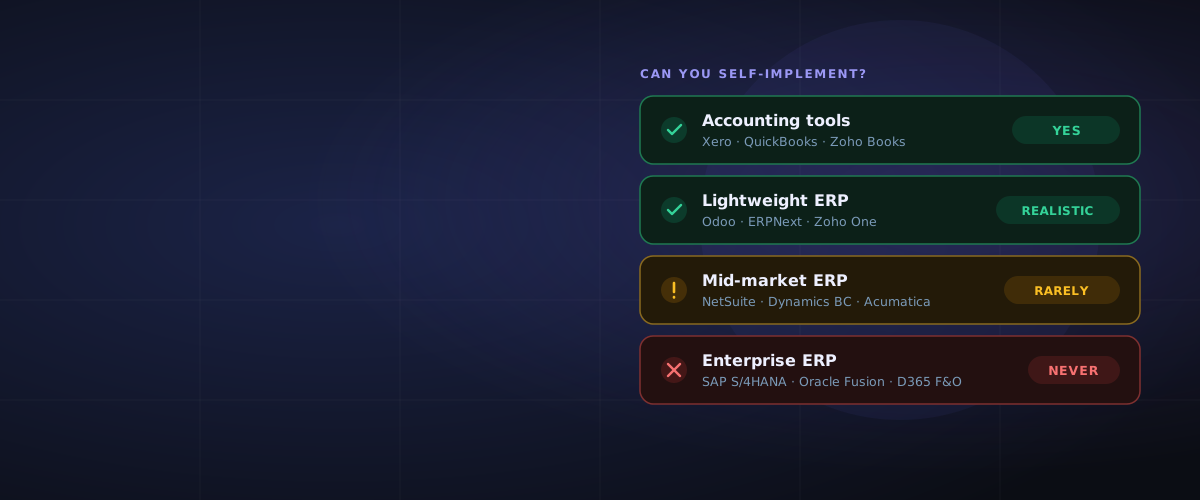
For accounting-only stacks, Xero, QuickBooks Online, and Zoho Books itself sit below Zoho One — but accounting alone leaves CRM, projects, HR, and operations to other tools that you then have to integrate. The major-vendor vs niche-ERP guide covers how to think about horizontal suite vs industry-specific platforms.
The vendors above suit different patterns — which one fits your business depends on the hundred-plus variables a proper evaluation surfaces.
For capabilities and fit, see the Zoho One platform profile. Compare it head-to-head: Zoho One vs Zoho Books, Zoho One vs Odoo, Zoho One vs Dynamics 365 Business Central.
Frequently Asked Questions
How much does Zoho One cost?
Zoho One has two pricing models. Employee Pricing is roughly $37 per employee per month and requires every employee in your business to be licensed — not just app users. Flexible User Pricing is roughly $90 per user per month and lets you license only the people actually using Zoho. A typical small business Year-1 total — licence plus implementation plus customisation — runs $20,000–$110,000 USD. Headcount drives the range more than any other variable.
Is Zoho One a real ERP?
Depends on your definition. Zoho One is not a single integrated transactional ERP in the NetSuite, SAP, or Dynamics 365 sense — it is a tightly-linked suite of 45+ separate applications that share users, contacts, and data. For service-led small businesses, it does the job an ERP would do. For product manufacturers, businesses with complex inventory, or organisations needing deep financial controls and multi-entity consolidation, Zoho One is not deep enough and you should look at a genuine ERP one tier up.
What are Zoho One's main pros and cons?
Pros: published per-employee pricing, broad functional coverage across CRM, finance, projects, HR, and operations, strong global localisation, fast deployment, and the lowest entry cost in the small business tier for broad-suite needs. Cons: all-employee licensing penalises high-headcount businesses, depth limits across the suite (no best-in-class capability anywhere), thin manufacturing, walled-garden architectural assumptions, and ecosystem lock-in once you wire 15+ apps together. It is breadth-first, depth-second.
Who owns Zoho One?
Zoho One is a product of Zoho Corporation, a privately held, bootstrapped software company founded in 1996 by Sridhar Vembu. Headquartered in Chennai, India, with major operations in Austin, Texas and offices across Europe and Asia, Zoho is one of the largest privately held SaaS companies in the world — and unusual for never having taken venture capital or gone public. The independence translates into a long product roadmap and stable pricing relative to publicly-listed competitors.
Can I implement Zoho One myself?
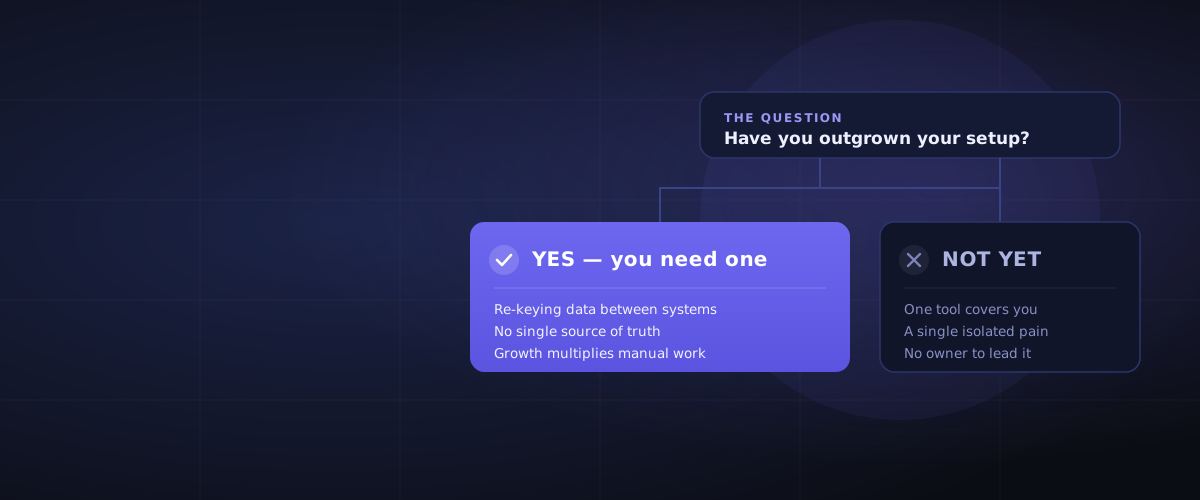
For a small services business with under 20 employees, plenty of buyers do exactly this — particularly if they start with two or three core apps (Books, CRM, Inventory) and expand gradually. The risk of DIY is not the install — it is the cross-app data model and shared records becoming a mess that is expensive to fix later. A partner-led deployment for a 25-employee business typically runs two to four months. The phased modular pattern suits Zoho One particularly well — go live on one app cluster at a time.
How long does Zoho One implementation take?
A focused Zoho One implementation runs two to four months for a 25-employee services business starting with CRM, Books, Projects, and Inventory. Adding HR, Payroll, Desk, and custom Creator apps extends to six to nine months. The most common timeline killer is scope sprawl — turning on too many apps without governance. Realistic ERP timelines across vendors are in how long ERP implementation takes. Disciplined phasing matters more on Zoho One than on most platforms because the temptation to "just enable one more app" is constant.
What are Zoho One's main alternatives?
Direct peers: Odoo (modular ERP, per-app pricing, deeper operations), ERPNext (open-source ERP, lowest licence cost), Salesforce + Xero/QuickBooks (best-of-breed CRM + accounting). One tier up: Dynamics 365 Business Central and SAP Business One offer real ERP depth at far higher cost. The realistic decision is between Zoho One's breadth-at-one-price model and a best-of-breed stack of specialist tools. Both are defensible; which is right for your business depends on depth requirements, headcount shape, and integration appetite.
Does Zoho One work for international businesses?
Yes — global availability is one of Zoho One's strongest features. Zoho Books has localisation for the US, UK, EU (including OSS/IOSS VAT), India GST, AU GST, Saudi ZATCA, UAE VAT, Canada, and many other regimes. Multi-currency is core. Multi-entity consolidation is the structural weakness — Zoho Books does not handle group consolidation natively, so businesses with multiple legal entities end up doing manual workarounds or pushing data into Zoho Analytics for consolidated reporting. For genuine multi-entity finance, you outgrow Zoho One.
How ERPLenz Can Help
ERPLenz has no Zoho partner agreement, no referral fee, and no skin in whether you buy Zoho One, Odoo, ERPNext, or stay on your existing stack for another year. Our job is to take your business through a 116-point diagnostic, calibrated to your actual headcount shape, industry, geography, and complexity, and produce a defensible answer.
The ERPLenz assessment outputs a ranked shortlist of three platforms with fit scores, a 5-year TCO calibrated to your situation, risk flags per platform, and — on the Deep Report — partner recommendations in your region. Read this guide as the floor of your evaluation, not the ceiling.
Begin your free ERP assessment →
Zoho One sells itself with a single number — $37 per employee per month — and the harder, more useful number is what the whole stack actually costs your specific business over five years. That is the number we exist to surface.