NetSuite vs Odoo: The Honest 2026 Comparison for Mid-Market Buyers
Quick answer: Choose NetSuite if you're a multi-entity, audit-ready mid-market business that needs OneWorld-grade consolidation, ASC 606/IFRS 15 revenue recognition, and a fully-managed cloud suite — and you can absorb the premium. Choose Odoo if you're a cost-sensitive small or mid-market organisation that values open-source flexibility, strong manufacturing and e-commerce coverage, and a 3–5x lower five-year TCO. NetSuite optimises for polish and audit-readiness; Odoo optimises for breadth, customisation, and price.
NetSuite and Odoo sit at opposite ends of the ERP universe — and yet they end up on the same shortlist constantly. One is a polished, premium-priced cloud suite from Oracle. The other is a modular, open-core platform from a Belgian company with a global community of contributors.
If you're comparing them, you're really weighing breadth and polish against flexibility and cost. That's the decision underneath the feature checklist.
This guide cuts through the noise. It compares architecture, hosting models, total cost of ownership, customisation, industry fit, and the gritty implementation realities that vendor websites won't show you. We've pulled from over 200 implementation post-mortems and 2026 pricing data across US, UK, EU, Australia, and India deployments. There is no universal winner — only the platform that fits your business.
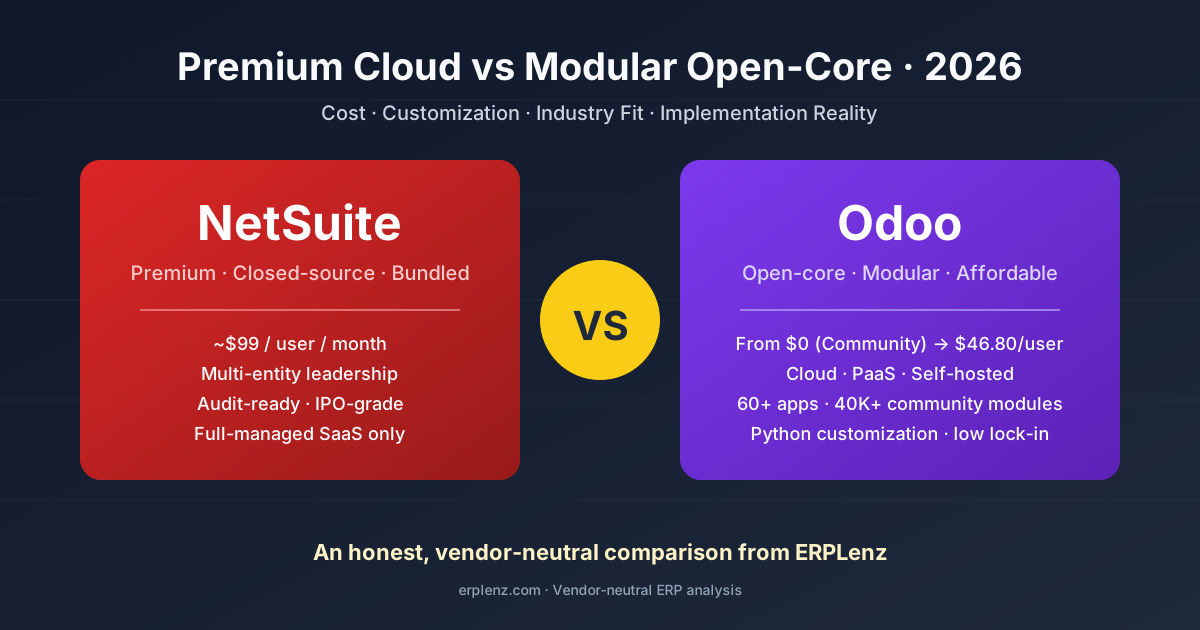
Quick-Glance Comparison Table
| Dimension | NetSuite (Oracle) | Odoo |
|---|---|---|
| Origin & model | 1998 · Closed-source SaaS | 2005 · Open-core (Community OSS, Enterprise paid) |
| Hosting options | Public cloud only | Odoo Online (SaaS) · Odoo.sh (PaaS) · Self-hosted |
| Best fit | Multi-entity, services, SaaS, e-commerce, $25M+ revenue | SMB to mid-market, $1M–$100M revenue, manufacturing, retail, services |
| Starting price | ~$999 base + ~$99/user/mo (USD) | $0 Community · ~$31.10/user/mo Enterprise Standard |
| Implementation time | 4–9 months typical | 1–6 months typical |
| Implementation cost | $75K–$500K+ | $5K–$185K |
| Customisation | SuiteScript (JavaScript), sandboxed | Python + XML, full source access in Community |
| Apps / modules | Bundled by edition + ~600 SuiteApps | 60+ official apps + 40,000+ community modules |
| Manufacturing | Light to moderate | Strong (MRP, PLM, Quality, Maintenance, Shop Floor) |
| E-commerce | SuiteCommerce (premium add-on) | Native website + e-commerce included |
| Multi-entity | OneWorld — best-in-class | Multi-company, improving in v17/v18 |
| Regional tax engines | Strong (Avalara typical add-on) | Native VAT, GST, MTD, ZATCA, India GST in 70+ countries |
| Annual updates | 2 mandatory upgrades/year | 1 major release/year (v17, v18, v19...) |
| Vendor lock-in risk | High — proprietary platform | Low — Community fork is OSS |
Architecture & Hosting: Where the Two Platforms Diverge Most
Architecture decisions ripple into everything: cost, customisation, upgrade pain, and exit strategy. This is the section to read first.
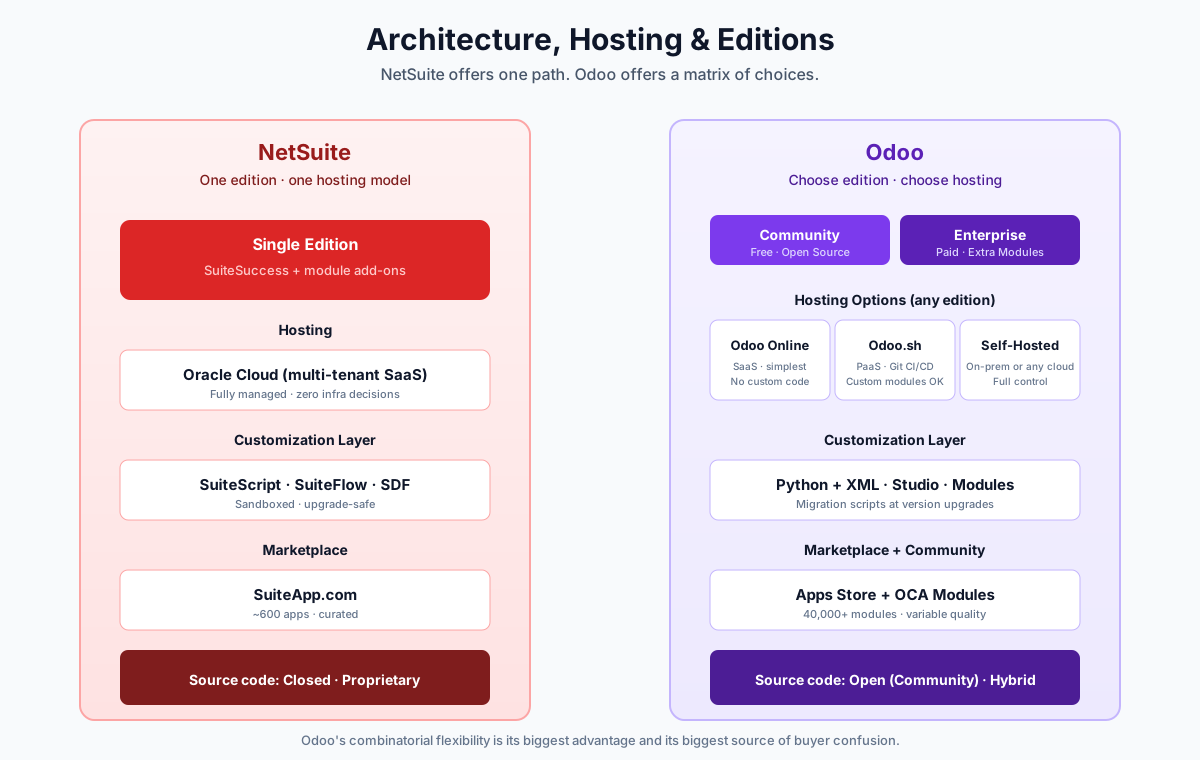
NetSuite: One Path Only
NetSuite is a closed-source, true multi-tenant SaaS application. Every customer in the world runs on the same codebase, hosted in Oracle's data centres. You don't choose the database, you don't choose the region (much), and twice a year you're upgraded with everyone else.
For organisations that don't want infrastructure decisions, this is a feature. There's nothing to manage, no upgrade backlog, no patching schedule. The trade-off: you sacrifice flexibility and pay a premium for that simplicity. There is no on-premises option, ever.
Odoo: A Three-Way Hosting Decision
Odoo's flexibility starts with hosting. You pick the path that fits your team, budget, and risk tolerance.
- Odoo Online (SaaS) — hosted by Odoo S.A., fully managed. Limited to standard Enterprise modules; no custom code. Cheapest and fastest to start. Best for SMBs with no customisation plans.
- Odoo.sh (PaaS) — developer-friendly cloud with staging environments, Git integration, CI/CD, daily backups, and custom module deployment. The sweet spot for most growing businesses.
- Self-hosted — run it on your servers, AWS, Azure, GCP, or anywhere. Full control, full responsibility. Recommended only with real DevOps capacity or specific data sovereignty requirements (common in the EU, GCC, and certain APAC regulated sectors).
Community Edition (free, open-source) and Enterprise Edition (paid) layer on top of any hosting choice. This combinatorial model is uniquely powerful — and uniquely confusing for buyers new to the ecosystem.
Open Source vs Closed Source: What It Actually Means
Odoo's open-source heritage isn't a license technicality. It changes your strategic posture:
- No vendor lock-in (in theory): with Community, you have the source. You can fork, self-host, or change partners — data and customisations remain yours.
- Massive community ecosystem: the OCA (Odoo Community Association) maintains thousands of free modules covering niche industries.
- Auditability: regulated organisations sometimes require source-level auditability that closed SaaS cannot offer.
- You inherit the responsibility: security patches, version upgrades, and backups in self-hosted setups are real engineering work.
NetSuite trades these freedoms for a fully managed experience. There's no "fork your ERP" option. If you want out, you migrate — see our ERP data migration guide for what that actually looks like.
Pricing & Licensing: A Side-by-Side With Real Numbers
Vendor pricing pages are misleading by design. Here are the real 2026 numbers based on published rate cards and recent customer quotes across US, UK, and EU deployments.
NetSuite Licensing (Annual, USD)
| Component | Cost |
|---|---|
| Base platform fee | ~$999/month (mandatory) |
| Full user license | ~$99–$129/month per user |
| Limited / self-service user | ~$15/month per user |
| Modules (OneWorld, Manufacturing, SuiteCommerce, etc.) | $300–$2,000+/month each |
| Annual renewal uplift | 8–15% historically common |
| Contract length | Typically 3 years, paid annually |
A 50-user mid-market deployment runs roughly $130K–$220K per year in subscription alone, before implementation.
Odoo Licensing (Annual, USD, 2026)
| Component | Cost |
|---|---|
| Community Edition | $0 forever (self-hosted) |
| Enterprise Standard | ~$31.10/user/month (Online hosting, no custom modules) |
| Enterprise Custom | ~$46.80/user/month (Odoo.sh or self-hosted, custom dev, Studio, multi-company) |
| Odoo.sh hosting | From ~$72/month per worker |
| Mandatory base fee | None — per-user pricing only |
| Annual renewal uplift | Generally flat |
A 50-user mid-market deployment on Enterprise Custom runs roughly $28K per year in subscription. Roughly 5–8x cheaper than NetSuite at the same headcount.
Implementation Costs (USD, 50-User Mid-Market)
| Cost bucket | NetSuite | Odoo |
|---|---|---|
| Discovery & design | $20K–$40K | $5K–$15K |
| Configuration | $40K–$80K | $10K–$30K |
| Customisation (average) | $30K–$100K | $10K–$60K |
| Data migration | $20K–$50K | $5K–$25K |
| Training | $10K–$25K | $3K–$15K |
| Project management | $15K–$30K | $5K–$15K |
| Contingency (15%) | $20K–$40K | $5K–$25K |
| Total implementation | $155K–$365K | $43K–$185K |
For a deeper breakdown of cost ranges across tiers, see how much ERP really costs.
5-Year TCO at 50 Users
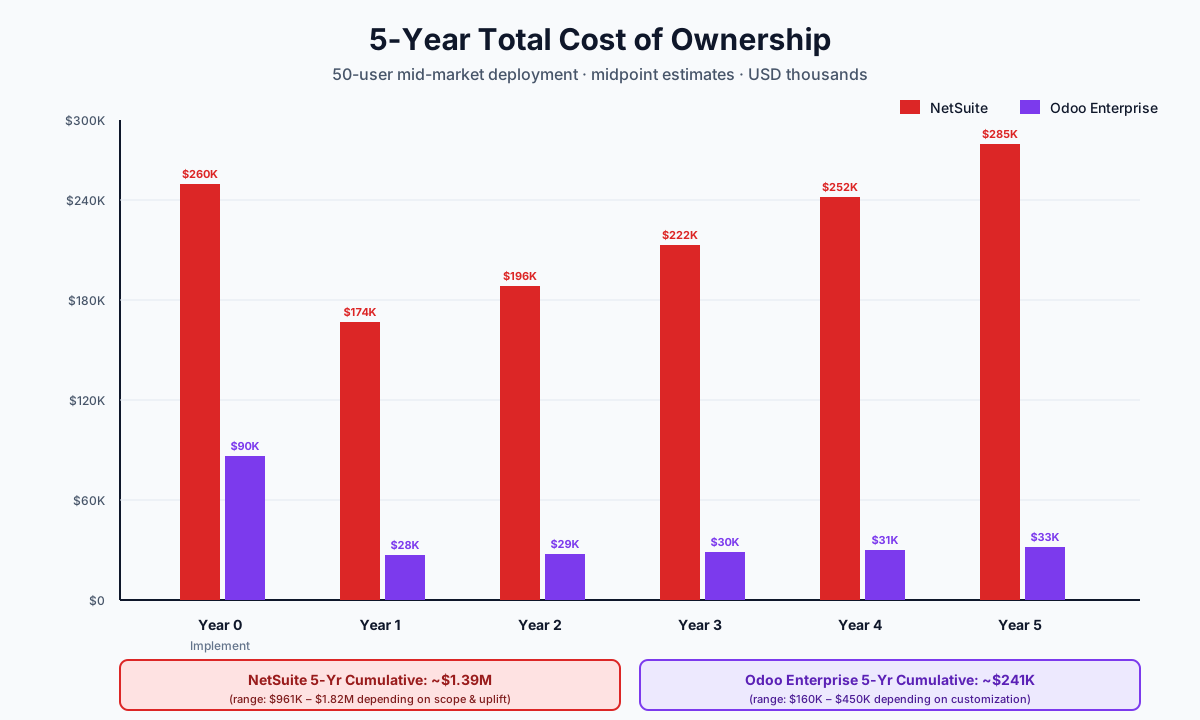
| Year | NetSuite (midpoint) | Odoo Enterprise Custom (midpoint) |
|---|---|---|
| Year 0 (implementation) | $260K | $90K |
| Year 1 subscription | $174K | $28K |
| Year 2 subscription | $196K | $29K |
| Year 3 subscription | $222K | $30K |
| Year 4 subscription | $252K | $31K |
| Year 5 subscription | $285K | $33K |
| 5-year total (midpoint) | ~$1.39M | ~$241K |
Reality check: Odoo's cost advantage is structural, but it shrinks if you require heavy customisation, OCA modules with maintenance burden, or premium partner support. The honest range for Odoo is $160K–$450K over five years. Even at the high end, it remains 3–5x cheaper than NetSuite.
Modules & Functional Coverage: How They Compare Out of the Box
This is where vendor demos blur. Both claim to cover "everything." Here's what each actually delivers without bolt-ons.
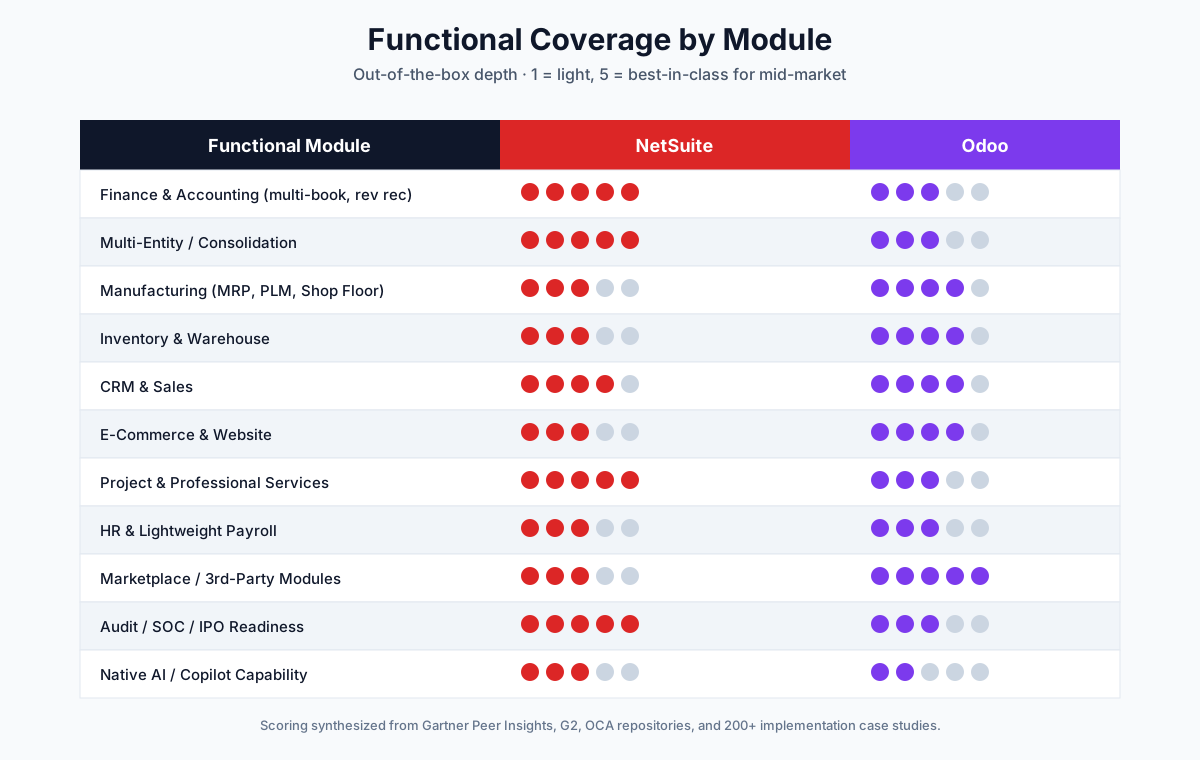
| Module | NetSuite | Odoo | Verdict |
|---|---|---|---|
| Finance & GL | Multi-book GAAP/IFRS/statutory, ASC 606, OneWorld consolidation | Solid double-entry, VAT/GST in 70+ countries, multi-currency | NetSuite for complex multi-entity; Odoo for typical mid-market |
| Manufacturing | SuiteSuccess Manufacturing — adequate for assembly | MRP, PLM, Quality, Maintenance, Shop Floor — surprisingly deep | Odoo wins decisively |
| CRM & Sales | Built-in, functional | Built-in (free in Community), modern UI | Roughly even, Odoo has nicer UX |
| E-commerce | SuiteCommerce (premium add-on) | Native website + e-commerce included | Odoo wins for SMB; NetSuite + Shopify wins for complex B2B |
| HR & Payroll | SuitePeople (US payroll, basic global) | Lightweight payroll, strong in EU/India/LATAM | Both mid-tier; most integrate specialist payroll |
| Project / PSA | SuiteProjects — industry-leading | Project + Timesheets + Helpdesk | NetSuite for complex billable services; Odoo for agencies |
| Warehouse / WMS | Solid core, advanced WMS as add-on | Multi-warehouse, barcode, dropship, routes — all included | Odoo wins for typical needs |
Regional Tax & Compliance
Both platforms handle the major global tax regimes, but with different defaults:
- UK MTD — Odoo has native HMRC bridge; NetSuite via Avalara or Tax Systems.
- EU VAT (incl. OSS/IOSS) — both native, Odoo's localisations are broader.
- US sales tax — both lean on Avalara at scale.
- Australia GST & STP — both supported; NetSuite stronger for multi-entity AU/NZ groups.
- India GST & e-invoicing — Odoo's India localisation is mature; NetSuite needs partner extensions.
- GCC ZATCA Phase 2 — both require certified ISV extensions.
If you operate across regions, your real test is the localisation depth in your specific countries, not the marketing map.
Customisation & Extensibility
NetSuite
- SuiteScript 2.x (JavaScript) for server-side logic, client scripts, scheduled jobs, REST integrations.
- SuiteFlow — no-code workflow builder.
- SuiteBuilder — custom records, fields, forms.
- SuiteCloud Development Framework (SDF) — source control + CI/CD for serious dev teams.
- Customisations live in a sandbox layer — twice-yearly forced upgrades rarely break custom code.
- Talent pool: moderate. NetSuite-specific developers are well-paid and not abundant.
Odoo
- Python + XML for custom modules. Clean MVC architecture, mature ORM.
- Odoo Studio — drag-and-drop customisation tool included in Enterprise Custom.
- Full source access in Community Edition. You can modify anything.
- Upgrades require migration scripts for custom modules — version-to-version migrations are a real engineering exercise. This is Odoo's biggest customisation gotcha.
- Talent pool: large and global. Python developers everywhere; OCA community provides vetted modules.
The honest customisation comparison: Odoo gives you more freedom but more responsibility. NetSuite gives you less freedom but lower upgrade risk. Choose based on your team's profile. For the philosophical frame, see how much ERP customisation is advisable.
Implementation Reality: What 200+ Project Post-Mortems Reveal
Typical Timelines
| Phase | NetSuite | Odoo |
|---|---|---|
| Discovery & design | 4–8 weeks | 2–4 weeks |
| Configuration & customisation | 8–16 weeks | 4–10 weeks |
| Data migration | 4–8 weeks | 2–6 weeks |
| Testing & UAT | 4–6 weeks | 2–4 weeks |
| Training & go-live | 4–6 weeks | 2–4 weeks |
| Total realistic range | 4–9 months | 1–6 months |
For a deeper view of timelines across vendors, see how long ERP implementations actually take.
Why Odoo Implementations Are Faster (When They Go Well)
- Smaller default scope per app — easier to phase by module.
- Simpler data model — Python developers reshape data quickly.
- Open source means you can iterate without vendor permission.
- Modern UI reduces training friction.
Why Odoo Implementations Sometimes Fail Catastrophically
- Underestimating module dependencies. Activating "just one more app" can cascade into unexpected schema changes.
- Choosing a low-cost partner without portfolio depth. Odoo's partner ecosystem is wider but more variable than NetSuite's.
- Treating open source as license to over-customise. Heavy modifications turn into upgrade nightmares at version transitions.
- No audit-grade testing. Without strict UAT, financial discrepancies surface post-go-live.
Why NetSuite Implementations Take Longer
- Multi-entity setup (OneWorld) adds weeks per subsidiary.
- Modules are deeply interlinked — partial implementation is harder.
- SuiteScript developer lead times are longer than Python.
- Stricter testing cycles required because of forced upgrades.
Universal Implementation Lessons
Panorama Consulting's 2025 ERP report and ISG research both confirm: both platforms fail for the same five reasons.
- Bad data going in. Plan 25–35% of effort on cleansing.
- Wrong implementation partner. Always interview the actual consultants on your project — see partner vs vendor-direct.
- Trying to launch all modules on day one. Phase your rollout — see big bang vs phased vs modular.
- Over-customisation before adopting standard flows. Both platforms have more out-of-the-box capability than most teams realise.
- Inadequate executive sponsorship. ERP failure is rarely technical; it's almost always organisational. See why ERP implementations fail.
Industry Fit: Which Platform for Which Business
NetSuite Wins For
- VC-backed SaaS preparing for Series B+ or audit/IPO
- Multi-subsidiary international organisations (OneWorld is unmatched in the mid-market)
- Professional services firms with complex billable utilisation and revenue recognition
- D2C and B2B e-commerce brands at $25M+ revenue with sophisticated operations
- Companies with no in-house IT capacity that want everything managed
- Organisations preparing for acquisition or IPO — auditors are familiar with NetSuite
Odoo Wins For
- SMB to mid-market manufacturers ($1M–$100M revenue) needing strong MRP and shop floor
- D2C brands at $1M–$25M that need integrated commerce + inventory + CRM
- Cost-sensitive growing companies that have outgrown Xero or QuickBooks but can't justify NetSuite pricing
- Service businesses, agencies, consultancies with straightforward revenue recognition
- International businesses with regional offices in countries Odoo localises well (most of Europe, India, LATAM, parts of APAC)
- Organisations with developer talent or willingness to engage Odoo partners for customisation
- Not-for-profits, education, retail chains — Odoo has strong vertical communities
Honest Disqualifiers
- Avoid Odoo if: you absolutely require best-in-class multi-book consolidation, complex SaaS revenue recognition, or have a board mandate for Tier-1 enterprise software.
- Avoid NetSuite if: you're cost-sensitive at <50 users, you value open source, or you need on-premises deployment.
- Both can fail if: you skip change management, training, and clean data migration. The platform isn't your problem — implementation discipline is.
A Decision Framework You Can Use Today
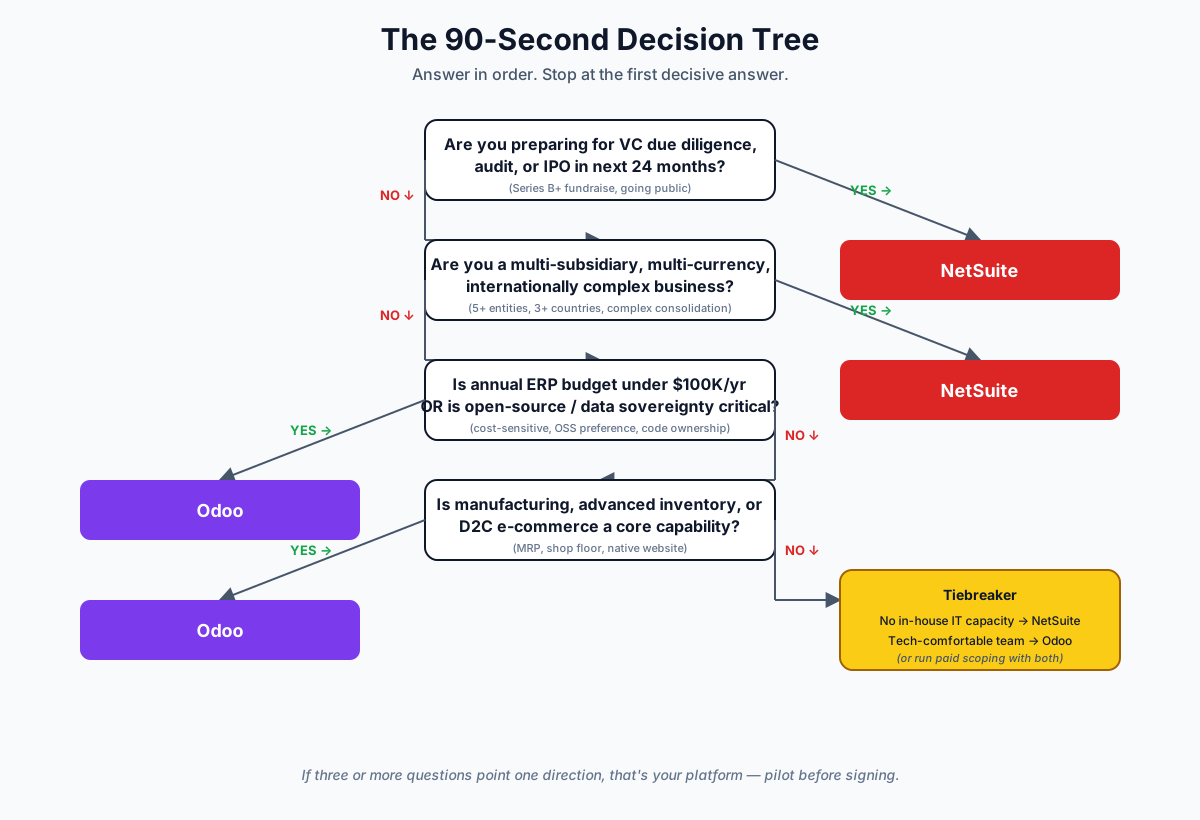
Forget the matrices. Answer these seven questions honestly:
- Is your annual revenue under $10M USD? → Odoo bias.
- Are you a multi-subsidiary international business? → NetSuite bias.
- Is manufacturing or distribution complex enough to justify a real ERP? → Both work; Odoo is cheaper and surprisingly strong.
- Do you have any in-house technical capacity (or willingness to hire a partner)? → Odoo opens up. If no → NetSuite.
- Are you preparing for VC due diligence, audit, or IPO in the next 24 months? → NetSuite bias.
- Are you budget-constrained? → Odoo wins on every dimension of price.
- Do you value open source / data sovereignty? → Odoo only.
Score 4+ answers favouring one direction? That's your platform. If split, run a paid scoping engagement with one partner from each ecosystem before committing.
Frequently Asked Questions
Is Odoo really free?
Odoo Community Edition is free and open-source — you can self-host it forever at zero license cost. You still pay for hosting, maintenance, and customisation. Odoo Enterprise (additional features, official support, mobile apps, the Studio no-code tool) is paid: roughly $31.10/user/month for Standard and $46.80/user/month for Custom in 2026. The "free" label is accurate for licenses but not for total cost of ownership.
Can Odoo really replace NetSuite for a mid-market business?
For most SMB and many mid-market businesses up to $100M revenue, yes. Odoo v17 and v18 have closed a meaningful gap in accounting depth, multi-company, and manufacturing. For very large multi-entity organisations with complex consolidation, audit-heavy SaaS revenue recognition, or regulated public-company requirements, NetSuite remains the more defensible choice. The honest cutover point sits somewhere between $25M and $75M revenue depending on complexity.
What's the catch with Odoo's low pricing?
Two main trade-offs. First, version-to-version upgrades require engineering work, especially with custom modules — migration scripts are a real cost. Second, the partner ecosystem is wider but more variable in quality than NetSuite's vetted Alliance Partners. Both are manageable with discipline. Neither is a deal-breaker. Buyers who treat Odoo as "free ERP" and skip partner due diligence are the ones who fail.
Which is better for global multi-entity operations?
NetSuite OneWorld remains the gold standard for the mid-market. Native intercompany journals, automated currency translation, multi-book accounting (US GAAP + IFRS + statutory simultaneously), and consolidation across hundreds of subsidiaries — all without bolt-ons. Odoo's multi-company functionality has improved significantly in v17 and v18 but doesn't yet match OneWorld's depth in elimination journals and consolidation reporting. If you operate across 5+ entities in 3+ countries, NetSuite is the safer bet.
How do Odoo upgrades work, and how disruptive are they?
Odoo releases one major version per year (v17, v18, v19...). Standard modules upgrade smoothly via the official upgrade tool. Custom modules need migration scripts written by your partner or in-house developers — typically 5–15 person-days of work depending on customisation depth. Odoo Online customers upgrade automatically. Odoo.sh and self-hosted customers control their own timing, which is both freedom and responsibility.
How does Odoo handle UK MTD, EU VAT, Australia GST, and India GST?
Odoo's localisation coverage is one of its strongest assets. UK MTD has native HMRC bridging. EU VAT (including OSS/IOSS for e-commerce) is built in across all member states. Australia GST with BAS reporting is supported. India GST with e-invoicing and e-way bills is mature. NetSuite covers all of these too but often via Avalara or partner extensions rather than native modules. For multi-region businesses outside North America, Odoo's out-of-the-box localisations are frequently broader.
Is Odoo SOC 2 compliant and audit-ready?
Odoo Online (the SaaS offering from Odoo S.A.) holds ISO 27001 certification and aligns to SOC 2 controls. Self-hosted deployments inherit your own infrastructure's compliance posture — so the answer depends on how you run it. NetSuite holds SOC 1, SOC 2, ISO 27001, and a broader audit certification surface. For regulated industries or public-company readiness, NetSuite's posture is materially stronger.
What does e-commerce really look like on each platform?
Odoo ships a full website builder, blog, forum, and e-commerce engine in every Enterprise plan — natively integrated with inventory, CRM, and accounting. For SMB and content-driven D2C brands, the value is remarkable. NetSuite's SuiteCommerce is a premium-priced module with strong B2B capabilities, but most NetSuite customers integrate with Shopify or BigCommerce instead. For complex catalogues, large B2B, or omnichannel retail at scale, NetSuite + Shopify is the more common architecture.
The Final Verdict
The choice between NetSuite and Odoo is fundamentally a choice between integrated polish at premium cost and modular flexibility at a fraction of the price.
Choose NetSuite if:
- You're a multi-entity, audit-heavy, or VC-backed business
- You value a single-vendor, fully-managed cloud platform
- You have the budget for premium subscription and implementation
- You need OneWorld-class consolidation or SuiteProjects-class PSA
- You're preparing for IPO or strategic acquisition
Choose Odoo if:
- You're a cost-sensitive SMB or mid-market business
- You value open source, customisation freedom, and exit optionality
- You have manufacturing, distribution, or e-commerce as core functions
- You have technical capacity (or a strong partner) to manage a more hands-on platform
- You want to grow your ERP investment without doubling subscription every renewal
There is no universally "better" platform. There is only the one that fits your size, complexity, and operating philosophy. Buy accordingly.
Next Steps
Before signing anything:
- Run parallel scoping engagements with one partner from each ecosystem. Compare not just proposals, but how well they understand your industry.
- Build your own 5-year TCO model, including realistic implementation, customisation, and ISV costs.
- Demand reference customer calls with companies of your exact size, region, and industry. Demos lie; reference customers usually don't.
- Pilot a proof-of-concept on one process (quote-to-cash is a good one) before committing to either platform.
- Many growing businesses start on Odoo and migrate to NetSuite when they hit scale. Some go the other way for cost reduction. Either path is well-trodden.
The right ERP decision compounds over a decade. The wrong one defines your operational pain for the same length of time.
ERPLenz is independent of every ERP vendor on the market. We publish the comparisons, TCO models, and post-mortems we wish buyers had access to a decade ago — because picking the wrong platform is too expensive to do twice.
Further reading